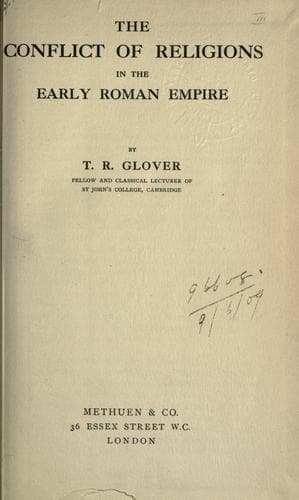
The Conflict of Religions in the Early Roman EmpireGlover, T. R. (Terrot Reaveley)
Religion
The Conflict of Religions in the Early Roman Empire
Glover, T. R. (Terrot Reaveley)
Christianity and other religions; Church history -- Primitive and early church, ca. 30-600; Rome -- Religion
But so far nothing has been said of Plutarch's own home. The lot of
the wife of a great preacher or moralist is not commonly envied; and
the tracts which Plutarch wrote upon historic women and their virtues,
and on the duties of married life, on diet and on the education of the
young, suggest that Timoxena must have lived in an atmosphere of high
moral elevation, with a wise saw and an ancient instance for every
occurrence of the day. But it is clear that he loved her, and his
affection for their four little boys must have been as plain to her as
to his readers--and his joy when, after long waiting, at last a little
girl was born. "You had longed for a daughter {86} after four sons,"
he writes to her, "and I was glad when she came and I could give her
your name." The little Timoxena lived for two years, and the letter of
consolation which Plutarch wrote her mother tells the story of her
short life. "She had by nature wonderful good temper and gentleness.
So responsive to affection, so generous was she that it was a pleasure
to see her tenderness. For she used to bid her nurse give the breast
to other children and not to them only, but even to toys and other
things in which she took delight. She was so loving that she wished
everything that gave her pleasure to share in the best of what she had.
I do not see, my dear wife, why things such as these, which gave us so
much happiness while she lived, should give us pain and trouble now
when we think of them."[44] He reminds her of the mysteries of
Dionysus of which they were both initiates. In language that recalls
Wordsworth's great Ode on the Intimations of Immortality, he suggests
that old age dulls our impressions of the soul's former life, and that
their little one is gone from them, before she had time to fall in love
with life on earth. "And the truth about this is to be seen in the
ancient use and wont of our fathers," who did not observe the ordinary
sad rites of burial for little children, "as if they felt it not right
in the case of those who have passed to a better and diviner lot and
place.... And since to disbelieve them is harder than to believe, let
us comply with the laws in outward things, and let what is within be
yet more stainless, pure and holy."[45]
Two of the sons had previously died--the eldest Soclaros, and the
fourth, "our beautiful Chaeron"--the name is that of the traditional
founder of Chaeronea. The other two, Autobulus and Plutarch grew up.
Some of these names appear in the _Table Talk_, while others of his
works were written at the suggestion of his sons.
[Sidenote: His slaves]
Public-domain text, read in full here on John Shaqi.
Reviews
Reviews
No reviews yet
Be the first to share your thoughts on this work.
Elsewhere in the archive
Join the Discussion
Join the discussion
Sign in to leave a comment or review.
Sign InorCreate an account