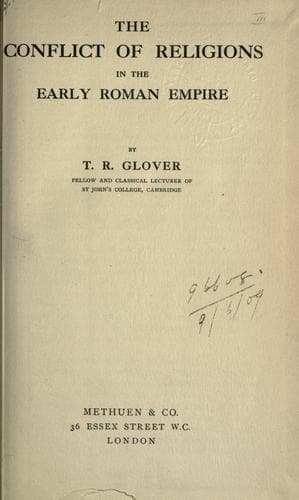
The Conflict of Religions in the Early Roman EmpireGlover, T. R. (Terrot Reaveley)
Religion
The Conflict of Religions in the Early Roman Empire
Glover, T. R. (Terrot Reaveley)
Christianity and other religions; Church history -- Primitive and early church, ca. 30-600; Rome -- Religion
From the family we pass to the slaves, and here, as we should expect,
Plutarch is an advocate of gentleness. In the tract _On Restraining
Anger_ a high and humane character is drawn in Fundanus, who had
successfully mastered a naturally passionate temper. It has been
thought that Plutarch was drawing {87} his own portrait over his
friend's name. A naive tendency to idealise his own virtues he
certainly shares with other moralists. Fundanus urges that, while all
the passions need care and practice if they are to be overcome, anger
is the failure to which we are most liable in the case of our slaves.
Our authority over them sets us in a slippery place; temper here has
nothing to check it, for here we are irresponsible and that is a
position of danger. A man's wife and his friends are too apt to call
gentleness to the slaves mere easy-going slackness (_atonian kai
rhathumian_). "I used to be provoked by such criticism myself against
my slaves. I was told they were going to pieces for want of
correction. Later on I realized that, first of all, it is better to
let them grow worse through my forbearance than by bitterness and anger
to pervert oneself for the reformation of others. And, further, I saw
that many of them, through not being punished, began to be ashamed of
being bad, and that forgiveness was more apt than punishment to be the
beginning of a change in them--and indeed that they would serve some
men more readily for a silent nod than they would others for blows and
brandings. So I persuaded myself that reasoning does better than
temper."[46] It will be remarked that Fundanus, or his recording
friend, does not here take the Stoic position that the slave is as much
a son of God as the master,[47] nor does he spare the slave for the
slave's sake but to overcome his own temper. So much for theory; but
men's conduct does not always square with their theories, and in life
we see men guilty of kind-heartedness and large-mindedness not at all
to be reconciled with the theories which they profess, when they
remember them.
Public-domain text, read in full here on John Shaqi.
Reviews
Reviews
No reviews yet
Be the first to share your thoughts on this work.
Elsewhere in the archive
Join the Discussion
Join the discussion
Sign in to leave a comment or review.
Sign InorCreate an account