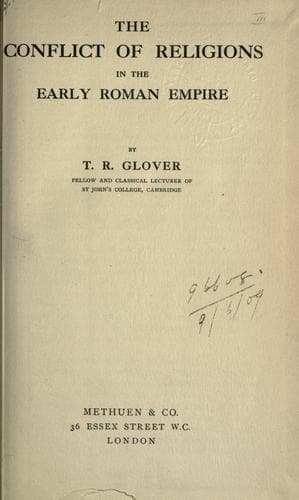
The Conflict of Religions in the Early Roman EmpireGlover, T. R. (Terrot Reaveley)
Religion
The Conflict of Religions in the Early Roman Empire
Glover, T. R. (Terrot Reaveley)
Christianity and other religions; Church history -- Primitive and early church, ca. 30-600; Rome -- Religion
A good deal has been written about Plutarch's philosophy. His works
are full of references to philosophy and philosophers, and he leaves us
in no doubt as to his counting himself a disciple of Plato; his
commentaries on Platonic doctrines give him a place in the long series
of Plato's expositors. But no one would expect a writer of the first
century to be a man of one allegiance, and Plutarch modifies the
teaching of Plato with elements from elsewhere. It has then been
debated whether he should, or should not, be called an Eclectic, but
not very profitably. The essential thing to note is that he is not
properly a philosopher at all, much as the statement would have
astonished him.[53] His real interest is elsewhere; and while he, like
the Greeks of his day, read and talked Philosophy interminably, as men
in later ages have read and talked Theology, it was not with the
philosophic spirit. Philosophy is not the mistress--rather, he avows,
the servant of something else; and that means that it is not
Philosophy. His test of philosophic thought and doctrine was
availability for the moral and religious life--a test which may or may
not be sound, as it is applied. But Plutarch was an avowed moralist,
didactic in every fibre; and everything he wrote betrays the essential
failure of the practical man and the moralist--impatience, the short
view. From his experience of human life in its manifold relations of
love and friendship, he came to the conclusion that "the ancient faith
of our fathers suffices." It is also plain that he was afraid of life
without religion. So far as a man of his training would--a man
familiar with the history of philosophy, but without patience or depth
enough to be clear in his own mind, he associated truth with his
religion; at all events it was "sufficient," for this he had found in
his course through the world. Definite upon this one central point, he
approached philosophy, but not with the true philosopher's purpose of
examining his experience, in accordance with the Platonic {90}
suggestion[54]; rather, with the more practical aim of profiting by
every serviceable thought or maxim which he could find. And he
certainly profited. If he started with preconceptions, which he
intended to keep, he enlarged and purified them--in a sense, we may
say, he adorned and enriched them. For whereever he found a moving or
suggestive idea, a high thought, he adopted it and found it a place in
his mind, though without inquiring too closely whether it had any right
to be there. In the end, it is very questionable whether the sum of
his ideas will hold together at all, if we go beyond the quick test of
a rather unexamined experience. We have already seen how he protested
against too curious examination. "There is no philosophy possible,"
wrote John Stuart Mill, "where fear of consequences is a stronger
principle than love of truth."
Public-domain text, read in full here on John Shaqi.
Reviews
Reviews
No reviews yet
Be the first to share your thoughts on this work.
Elsewhere in the archive
Join the Discussion
Join the discussion
Sign in to leave a comment or review.
Sign InorCreate an account