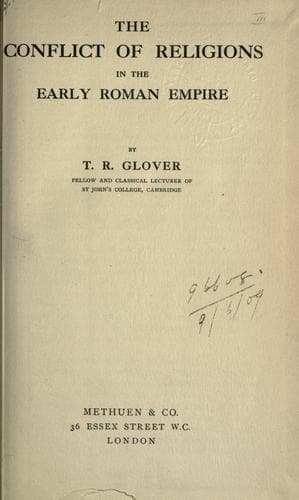
The Conflict of Religions in the Early Roman EmpireGlover, T. R. (Terrot Reaveley)
Religion
The Conflict of Religions in the Early Roman Empire
Glover, T. R. (Terrot Reaveley)
Christianity and other religions; Church history -- Primitive and early church, ca. 30-600; Rome -- Religion
But to such criticisms a reply is sometimes suggested, which is best
made in the well-known words of Pascal--"the heart has its reasons
which the reason does not know."[55] The experience which led Plutarch
to his conclusion was real and sound. There is an evidential value in
a good father, in wife and children--even in a telearchy with its tiles
and cement--which is apt to be under-estimated. For with such elements
in life are linked passions and emotions, which are deeply bound up
with human nature, and rule us as instincts--blind reasons of the
heart. Like all other things they require study and criticism if they
are not to mislead, and those who most follow them are sometimes the
worst judges of their real significance. On the other hand the danger
of emotion, instinct and intuition as guides to truth is emphasized
enough,--it was emphasized by the Stoics; and a contribution is made to
human progress, when the value of these guides to truth is re-asserted,
even to the extent of obvious exaggeration, by some one, who, like
Plutarch, has had a life rich in various human experience. It remains
however, in Plutarch's case as in all such cases, the fundamental
question, whether the supposed testimony of instinct and intuition is
confirmed. If it is not confirmed, it may be taken to have been
misunderstood.
Keeping the whole life of this man in view, and realizing its
soundness, its sweetness and its worth, we must see what {91} he made
of the spiritual environment of man's life in general--laying stress on
what in his system, or his attempt at a system, is most significant,
and postponing criticism. It should be said once for all that a
general statement of Plutarch's views cannot be quite faithful, for he
was a man of many and wandering thoughts, and also something of an
Academic; and whatever he affirmed was with qualifications, which in a
short summary must be understood rather than repeated.
[Sidenote: The knowledge of God]
Our knowledge of God and of things divine comes to us, according to
Plutarch, from various sources. There is the consensus of mankind.
"Of all customs first and greatest is belief in gods. Lycurgus, Numa,
Ion and Deucalion, alike sanctified men, by prayers and oaths and
divinations and oracles bringing them into touch with the divine in
their hopes and fears. You might find communities without walls,
without letters, without kings, without houses, without money, with no
need of coinage, without acquaintance with theatres and gymnasia; but a
community without holy rite, without a god, that uses not prayer nor
oath, nor divination, nor sacrifice to win good or avert evil--no man
ever saw nor will see.... This is what holds all society together and
is the foundation and buttress of all law."[56]
Public-domain text, read in full here on John Shaqi.
Reviews
Reviews
No reviews yet
Be the first to share your thoughts on this work.
Elsewhere in the archive
Join the Discussion
Join the discussion
Sign in to leave a comment or review.
Sign InorCreate an account