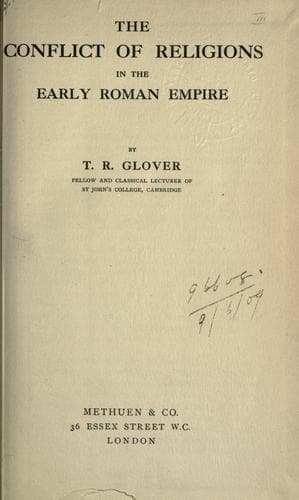
The Conflict of Religions in the Early Roman EmpireGlover, T. R. (Terrot Reaveley)
Religion
The Conflict of Religions in the Early Roman Empire
Glover, T. R. (Terrot Reaveley)
Christianity and other religions; Church history -- Primitive and early church, ca. 30-600; Rome -- Religion
Philosophy, poetry, tradition, oracles and mysteries[63] bring Plutarch
to belief in gods. "There are not Greek gods and barbarian, southern
or northern; but just as sun, moon, sky, earth and sea are common to
all men and have many names, so likewise it is one Reason that makes
all these things a cosmos; it is one Providence that cares for them,
with ancillary powers appointed to all things; while in different
people, different honours and names are given to them as customs vary.
Some use hallowed symbols that are faint, others symbols more clear, as
they guide their thought to the divine."[64] This one ultimate Reason
is described by Plutarch in terms borrowed from all the great teachers
who had spoken to the Greeks of God. The Demiurge, the One and
Absolute, the World-Soul and the rest all contribute features.[65]
"We," he says, "have really no share in Being, but every mortal nature,
set between becoming and perishing, offers but a show and a seeming of
itself, dim and insecure"; and he quotes the famous saying of
Heraclitus that it is impossible to descend into the same river twice,
and develops the idea of change in the individual. "No one remains,
nor is he one, but we become many as matter now gathers and now slips
away about one phantasm and a common form (or impress).... Sense
through ignorance of Being is deceived into thinking that the
appearance is. What then indeed is Being? The eternal, free from
becoming, free from perishing, for which no time brings change.... It
is even impious to say 'Was' or 'Will be' of Being; for these are the
varyings and passings and changings of that which by nature cannot
abide in Being. But God _is_, we must say, and that _not_ in time, but
in the aeon that knows no motion, time or variation, where is neither
former {94} nor latter, future nor past, older nor younger; but God is
one, and with one Now he has filled Always, and is alone therein the
one that Is."[66]
Public-domain text, read in full here on John Shaqi.
Reviews
Reviews
No reviews yet
Be the first to share your thoughts on this work.
Elsewhere in the archive
Join the Discussion
Join the discussion
Sign in to leave a comment or review.
Sign InorCreate an account