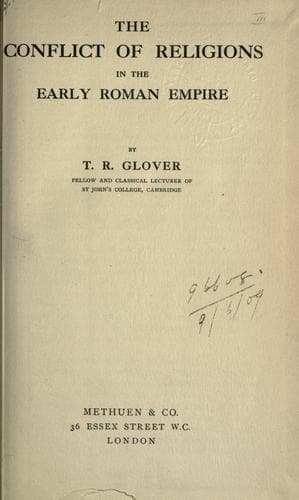
The Conflict of Religions in the Early Roman EmpireGlover, T. R. (Terrot Reaveley)
Religion
The Conflict of Religions in the Early Roman Empire
Glover, T. R. (Terrot Reaveley)
Christianity and other religions; Church history -- Primitive and early church, ca. 30-600; Rome -- Religion
The symbol E at Delphi affords him a text here. It is one of "the kind
Apollo's" riddles to stimulate thought. Plutarch read it as Epsilon
and translates it "Thou Art," and from this as from the very name of
Apollo he draws a lesson as to the nature of real Being. The name
_A-poll-o_ means of itself the "Not-Many," and the symbol E is the
soul's address to God--God is, and God is one. Not every one
understands the nature of the divine; men confuse God with his
manifestations. "Those who suppose Apollo and the sun to be one and
the same, we should welcome and love for their pious speech, because
they attach the idea (_epinoia_) of God to that thing which they honour
most of all they know and crave for," but we should point them higher,
"bid them go upward and see the truth of their dream, the real Being
(_ten ousian_)." They may still honour the image--the visible sun.
But that a god should do the work of the sun, that there should be
changes and progressions in a god, that he should project fire from
himself and extend himself into land, sea, winds and animals, and into
all the strange experiences of animals and plants (as the Stoics
taught)--it is not holy even to hear such things mentioned. No, God is
not like Homer's child playing on the sand, making and unmaking; all
this belongs to another god, or rather daemon, set over nature with its
becomings and perishings.[67] To confuse gods and daemons is to make
disorder of everything.
It is here that the real interest of Plutarch's theology begins; for,
as Christian apologists were quick to point out, all the philosophers
were in the last resort monotheists. But the ultimate One God is by
common consent far from all direct contact with this or any other
universe of becoming and perishing. For it was questioned how many
universes (_kosmoi_) there might be[68]--some conjecturing there would
be one hundred and eighty-three--and if there were more than one, the
Stoics asked what became of Fate and Destiny, and would there not be
many "Zeuses or Zenes"? Why should there be? asked {95} Plutarch; why
not in each universe a guide and ruler with mind and reason, such as he
who in our universe is called lord and father of all? What hinders
that they should all be subjects of the Fate and Destiny that Zeus
controls; that he should appoint to each several one of them his own
realm, and the seeds and reasons of everything achieved in it; that he
should survey them, and they be responsible to him? That in the whole
scheme of things there should be ten universes, or fifty, or a hundred,
all governed by one Reason, all subordinate to one rule, is not
impossible. The Ultimate God rules through deputies.[69]
[Sidenote: The deputies of the supreme]
Public-domain text, read in full here on John Shaqi.
Reviews
Reviews
No reviews yet
Be the first to share your thoughts on this work.
Elsewhere in the archive
Join the Discussion
Join the discussion
Sign in to leave a comment or review.
Sign InorCreate an account