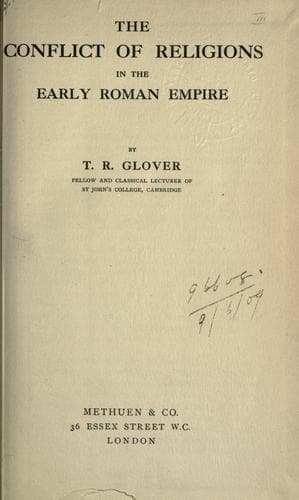
The Conflict of Religions in the Early Roman EmpireGlover, T. R. (Terrot Reaveley)
Religion
The Conflict of Religions in the Early Roman Empire
Glover, T. R. (Terrot Reaveley)
Christianity and other religions; Church history -- Primitive and early church, ca. 30-600; Rome -- Religion
Thus under the Supreme is a hierarchy of heavenly powers or gods, and
again between them and men is another order of beings, the daemons.[73]
These, unlike the gods, are of mixed nature, for while the gods are
emanations or Logoi of the Supreme, the daemons have something of the
perishable. "Plato and Pythagoras and Xenocrates and Chrysippus,
following the ancient theologians, say that daemons are stronger than
men and far excel us in their natural endowment; but the divine element
in them is not unmixed nor undiluted, but partakes of the soul's nature
and the body's sense-perception, and is susceptive of pleasure and
pain, while the passions which attend these mutations affect them, some
of them more and others less. For there are among daemons, as among
men, differences of virtue and wickedness."[74] "It can be proved on
the testimony of wise and ancient witnesses that there are natures, as
it were on the frontiers of gods and men, that admit mortal passions
and inevitable changes, whom we may rightly, after the custom of {97}
our fathers, consider to be daemons, and so calling them, worship
them."[75] If the atmosphere were abolished between the earth and the
moon (for beyond air and moon it was generally supposed that the gods
lived[76]), the void would destroy the unity of the universe; and in
precisely the same way "those who do not leave us the race of daemons,
destroy all intercourse and contact between gods and men, by abolishing
what Plato called the interpretive and ancillary nature, or else they
compel us to make confusion and disorder of everything, by bringing God
in among mortal passions and mortal affairs, fetching him down for our
needs, as they say the witches in Thessaly do with the moon."[77] And
"he, who involves God in human needs, does not spare his majesty, nor
does he maintain the dignity and greatness of God's excellence."[78]
The Stoic teaching that men are "parts of God" makes God responsible
for every human act of wickedness and sin--the common weakness of every
pantheistic system.[79]
Public-domain text, read in full here on John Shaqi.
Reviews
Reviews
No reviews yet
Be the first to share your thoughts on this work.
Elsewhere in the archive
Join the Discussion
Join the discussion
Sign in to leave a comment or review.
Sign InorCreate an account