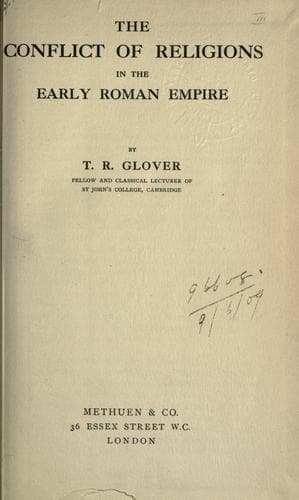
The Conflict of Religions in the Early Roman EmpireGlover, T. R. (Terrot Reaveley)
Religion
The Conflict of Religions in the Early Roman Empire
Glover, T. R. (Terrot Reaveley)
Christianity and other religions; Church history -- Primitive and early church, ca. 30-600; Rome -- Religion
Thus the daemons serve two purposes in religious philosophy. They
safeguard the Absolute and the higher gods from contact with matter,
and they relieve the Author of Good from responsibility for evil. At
the same time they supply the means of that relation to the divine
which is essential for man's higher life--"passing on the prayers and
supplications of men thitherward, and thence bringing oracles and gifts
of blessing."[80] "They say well, who say that when Plato discovered
the element underlying qualities that are begotten--what nowadays they
call matter and nature--he set philosophers free from many great
difficulties; but to me they seem to solve more difficulties and
greater ones, who set the race of daemons between gods and {98} men and
discovered that in some such way it made a community of us and brought
us together, whether the theory belongs to the Magians who follow
Zoroaster, or is Thracian and comes from Orpheus, or is Egyptian, or
Phrygian."[81] Homer, he adds, still uses the terms "gods" and
"daemons" alike; "it was Hesiod who first clearly and distinctly set
forth the four classes of beings endowed with reason, gods, daemons,
heroes and finally men."
The daemons, then, are the agents of Providence, of the One Reason,
which orders the universe; they are the ministers of the divine care
for man. And here perhaps their mediation is helped by the fact that
the border lines between themselves and the gods above on the one hand,
and men below on the other, are not fixed and final. Some daemons, such
as Isis, Osiris, Herakles and Dionysos, have by their virtue risen to
be gods,[82] while their own numbers have been recruited from the souls
of good men.[83] "Souls which are delivered from becoming (_geneseos_)
and thenceforth have rest from the body, as being utterly set free, are
the daemons that care for men, as Hesiod says";[84] and, just as old
athletes enjoy watching and encouraging young ones, "so the daemons, who
through worth of soul are done with the conflicts of life," do not
despise what they have left behind, but are kindly minded to such as
strive for the same goal,--especially when they see them close upon
their hope, struggling and all but touching it. As in the case of a
shipwreck those on shore will run out into the waves to lend a hand to
the sailors they can reach (though if they are out on the sea, to watch
in silence is all that can be done), so the daemons help us "while the
affairs of life break over us (_baptixomenous hypo ton pragmaton_) and
we take one body after another as it were carriages." Above all they
help us if we strive of our own virtue to be saved and reach the
haven.[85]
Public-domain text, read in full here on John Shaqi.
Reviews
Reviews
No reviews yet
Be the first to share your thoughts on this work.
Elsewhere in the archive
Join the Discussion
Join the discussion
Sign in to leave a comment or review.
Sign InorCreate an account