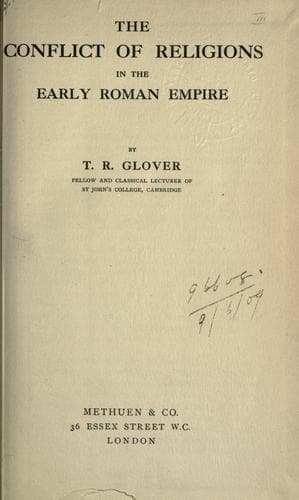
The Conflict of Religions in the Early Roman EmpireGlover, T. R. (Terrot Reaveley)
Religion
The Conflict of Religions in the Early Roman Empire
Glover, T. R. (Terrot Reaveley)
Christianity and other religions; Church history -- Primitive and early church, ca. 30-600; Rome -- Religion
Plutarch connects with his belief in the gods "the great hypothesis" of
immortality. "It is one argument that at one and the same time
establishes the providence of God and the continuance of the human
soul, and you cannot do away with the one and leave the other."[110]
If we had nothing divine in us, nothing like God, if we faded like the
leaves (as Homer said), God would hardly give us so much thought, nor
would he, like women with their gardens of Adonis, tend and culture
"souls of a day," growing in the flesh which will admit no "strong root
of life." The dialogue, in which this is said, is supposed to have
taken place in Delphi, so Plutarch turns to Apollo. "Do you think
that, if Apollo knew that the souls of the dying perished at once,
blowing away like mist or smoke from their bodies, he would ordain so
many propitiations for the dead, and ask such great gifts and honours
for the departed--that he would cheat and humbug believers? For my
part, I will never let go the continuance of the soul, unless some
Herakles shall come and take away the Pythia's tripod and abolish and
destroy the oracle. For as long as so many oracles of this kind are
given even in our day, it is not holy to condemn the soul to {105}
death."[111] And Plutarch fortifies his conviction with stories of
oracles, and of men who had converse with daemons, with apocalypses and
revelations, among which are two notable Descents into Hades,[112] and
a curious account of daemons in the British Isles.[113]
The theory of daemons lent itself to the explanation of the origin of
evil, but speculation in this direction seems not to have appealed to
Plutarch. He uses bad daemons to explain the less pleasant phases of
paganism, as we shall see, but the question of evil he scarcely
touches. In his book on Isis and Osiris he discusses Typhon as the
evil element in nature, and refers with interest to the views of "the
Magian Zoroaster who, they say, lived about five hundred years before
the Trojan War." Zoroaster held that there were two divine beings, the
better being a god, Horomazes (Ormuzd), the other a daemon Areimanios
(Ahriman), the one most like to light of all sensible things, the other
to darkness and ignorance, "and between them is Mithras, for which
reason the Persians call Mithras the Mediator." But the hour of
Mithras was not yet come, and in all his writings Plutarch hardly
alludes to him more than half a dozen times.[114] It should be noted
that, whatever his interest in Eastern dualism with its Western
parallels, Plutarch does not abandon his belief in the One Ultimate
Good God.
Public-domain text, read in full here on John Shaqi.
Reviews
Reviews
No reviews yet
Be the first to share your thoughts on this work.
Elsewhere in the archive
Join the Discussion
Join the discussion
Sign in to leave a comment or review.
Sign InorCreate an account