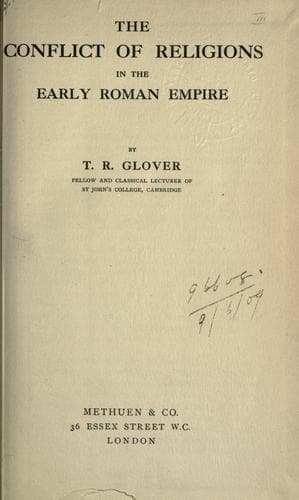
The Conflict of Religions in the Early Roman EmpireGlover, T. R. (Terrot Reaveley)
Religion
The Conflict of Religions in the Early Roman Empire
Glover, T. R. (Terrot Reaveley)
Christianity and other religions; Church history -- Primitive and early church, ca. 30-600; Rome -- Religion
With Philosophy so ready to be our mystagogue and to lead us into the
true knowledge of divine goodness, and with so helpful a theory to
explain away all that is offensive in traditional religion, faith ought
to be as easy as it is happy and wholesome. But there is another
danger beside Atheism--its exact opposite, superstition; and
here--apart from philosophical questions--lay the practical difficulty
of Plutarch's religion. He accepted almost every cult and mythology
which the ancient world had handed down; Polytheism knows no false
gods. But to guide one's course aright, between the true myth and the
depraved, to distinguish between the true and good god and the
pseudonymous daemon, was no easy task. The strange mass of Egyptian
misunderstandings was a testimony to this--some in their ignorance
thought the gods underwent the actual experience of the grain they gave
men to sow, just as untaught Greeks identified the gods with their
images; and some Egyptians worshipped the animals sacred to the gods;
and so religion was brought into contempt, while "the weak and
harmless" fell into unbounded superstition, and the shrewder and bolder
into "beastly and atheistic reflections."[124] And yet on second
thoughts Plutarch has a kindly apology for animal-worship.[125]
Plutarch himself wrote a tract on superstition in which some have found
a note of rhetoric or special pleading, for he decidedly gives the
atheist the superiority over the superstitious, {109} a view which
Amyot, his great translator, called dangerous, for "it is certain that
Superstition comes nearer the mean of true Religion than does
Atheism."[126] Perhaps it did in the sixteenth century, but in
Plutarch's day superstition was the real enemy to be crushed. Nearly
every superstitious practice he cites appears in other writers.
Public-domain text, read in full here on John Shaqi.
Reviews
Reviews
No reviews yet
Be the first to share your thoughts on this work.
Elsewhere in the archive
Join the Discussion
Join the discussion
Sign in to leave a comment or review.
Sign InorCreate an account