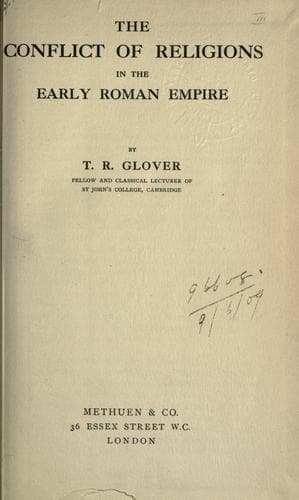
The Conflict of Religions in the Early Roman EmpireGlover, T. R. (Terrot Reaveley)
Religion
The Conflict of Religions in the Early Roman Empire
Glover, T. R. (Terrot Reaveley)
Christianity and other religions; Church history -- Primitive and early church, ca. 30-600; Rome -- Religion
Superstition, the worst of all terrors, like all other terrors kills
action. It makes no truce with sleep, the refuge from other fears and
pains. It invents all kinds of strange practices, immersions in mud,
baptisms,[127] prostrations, shameful postures, outlandish worships.
He who fears "the gods of his fathers and his race, saviours, friends
and givers of good"--whom will he not fear? Superstition adds to the
dread of death "the thought of eternal woes." The atheist lays his
misfortunes down to accident and looks for remedies. The superstitious
makes all into judgments, "the strokes of God," and will have no
remedies lest he should seem "to fight against God" (_theomachein_).
"Leave me, Sir, to my punishment!" he cries, "me the impious, the
accursed, hated of Gods and daemons"--so he sits in rags and rolls in
the mud, confessing his sins and iniquities, how he ate or drank or
walked when the daemonion forbade. "Wretched man!" he says to himself,
"Providence ordains thy suffering; it is God's decree." The atheist
thinks there are no gods; the superstitious wishes there were none. It
is they who have invented the sacrifices of children that prevailed at
Carthage[128] and other things of the kind. If Typhons and Giants were
to drive out the gods and become our rulers, what worse could they ask?
A hint from the _Conjugal Precepts_ may be added here, as it suggests a
difficulty in practice. "The wife ought not to have men friends of her
own but to share her husband's; and the gods are our first and best
friends. So those gods whom the the husband acknowledges, the wife
ought to worship and own, and those alone, and keep the great door shut
on superfluous devotions and foreign superstitions. No god really
enjoys the {110} stolen rites of a woman in secret."[129] This is a
counsel of peace, but if "ugly, ill-tempered and vengeful spirits" seem
to the mother to threaten her children, who will decide what are
superfluous devotions?
The religion of Plutarch is a different thing from his morality. For
his ethics rest on an experience much more easy to analyse, and like
every elderly and genial person he has much that he can say of the
kindly duties of life. Every reader will own the beauty and the high
tone of much of his teaching, though some will feel that its centre is
the individual, and that it is pleasant rather than compulsive and
inevitable. After all nearly every religion has, somewhere or other,
what are called "good ethics," but the vital question is, "What else?"
In the last resort is ecstasy, independently of morality, the main
thing? Are words and acts holy as religious symbols which in a society
are obviously vicious? What propellent power lies behind the morals?
And where are truth and experience?
[Sidenote: Apology or truth?]
Public-domain text, read in full here on John Shaqi.
Reviews
Reviews
No reviews yet
Be the first to share your thoughts on this work.
Elsewhere in the archive
Join the Discussion
Join the discussion
Sign in to leave a comment or review.
Sign InorCreate an account