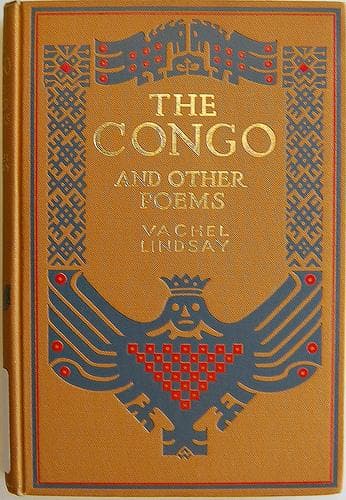
"The Eagle that is Forgotten" and "The Congo" are two of his best-known
poems, and appear in his first two volumes of verse, "General William
Booth Enters into Heaven" (1913) and "The Congo" (1914).
Lindsay himself considered his drawings and his prose writings to be as
important as his verse, all coming together to form a whole. His
"Collected Poems" (1925) gives a good selection.
*****
From an anthology of verse by Jessie B. Rittenhouse (1913, 1917):
"Lindsay, Vachel. Born November 10, 1879. Educated at Hiram College,
Ohio. He took up the study of art and studied at the Art Institute,
Chicago, 1900-03 and at the New York School of Art, 1904-05. For a time
after his technical study, he lectured upon art in its practical
relation to the community, and returning to his home in Springfield,
Illinois, issued what one might term his manifesto in the shape of "The
Village Magazine", divided about equally between prose articles,
pertaining to beautifying his native city, and poems, illustrated by his
own drawings. Soon after this, Mr. Lindsay, taking as scrip for the
journey, "Rhymes to be Traded for Bread", made a pilgrimage on foot
through several Western States going as far afield as New Mexico. The
story of this journey is given in his volume, "Adventures while
Preaching the Gospel of Beauty". Mr. Lindsay first attracted attention
in poetry by "General William Booth Enters into Heaven", a poem which
became the title of his first volume, in 1913. His second volume was
"The Congo", published in 1914. He is attempting to restore to poetry
its early appeal as a spoken art, and his later work differs greatly
from the selections contained in this anthology."
End of Project Gutenberg's The Congo and Other Poems, by Vachel Lindsay
Public-domain text, read in full here on John Shaqi.
Reviews
Reviews
No reviews yet
Be the first to share your thoughts on this work.
Join the Discussion
Join the discussion
Sign in to leave a comment or review.
Sign InorCreate an account