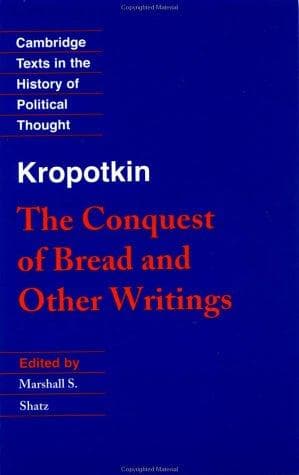
The Conquest of BreadKropotkin, Petr Alekseevich, kniaz
Philosophy
The Conquest of Bread
Kropotkin, Petr Alekseevich, kniaz
Anarchism; Communism
For it is remarkable that when economists, wishing to celebrate the
blessings of property, show us how an unproductive, marshy, or stony
soil is clothed with rich harvests when cultivated by the peasant
proprietor, they in nowise prove their thesis in favour of private
property. By admitting that the only guarantee not to be robbed of the
fruits of your labour is to possess the instruments of labour--which is
true--the economists only prove that man really produces most when he
works in freedom, when he has a certain choice in his occupations, when
he has no overseer to impede him, and lastly, when he sees his work
bringing in a profit to him and to others who work like him, but
bringing in little to idlers. Nothing else can be deducted from their
argumentation, and this is what we maintain ourselves.
As to the form of possession of the instruments of labour, the
economists only mention it _indirectly_ in their demonstration, as a
guarantee to the cultivator that he shall not be robbed of the profits
of his yield nor of his improvements. Besides, in support of their
thesis in favour of _private property_ against all other forms of
_possession_, should not the economists demonstrate that under the form
of communal property land never produces such rich harvests as when the
possession is private? But this they could not prove; in fact, it is the
contrary that has been observed.
Take for example a commune in the canton of Vaud, in the winter time,
when all the men of the village go to fell wood in the forest, which
belongs to them all. It is precisely during these festivals of labour
that the greatest ardour for work and the most considerable display of
human energy are apparent. No salaried labour, no effort of a private
owner can bear comparison with it.
Or let us take a Russian village, when all its inhabitants mow a field
belonging to the commune, or farmed by it. There you will see what man
_can_ produce when he works in common for communal production. Comrades
vie with one another in cutting the widest swathe, women bestir
themselves in their wake so as not to be distanced by the mowers. It is
a festival of labour, in which a hundred people accomplish in a few
hours a work that would not have been finished in a few days had they
worked separately. What a miserable contrast compared to them is offered
by the work of the isolated owner!
Public-domain text, read in full here on John Shaqi.
Reviews
Reviews
No reviews yet
Be the first to share your thoughts on this work.
Elsewhere in the archive
Join the Discussion
Join the discussion
Sign in to leave a comment or review.
Sign InorCreate an account