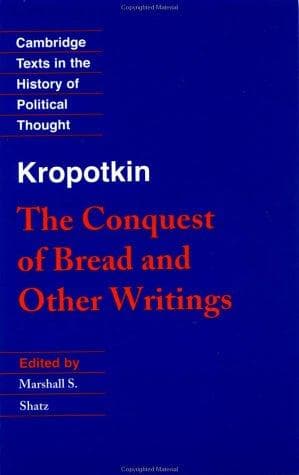
The Conquest of BreadKropotkin, Petr Alekseevich, kniaz
Philosophy
The Conquest of Bread
Kropotkin, Petr Alekseevich, kniaz
Anarchism; Communism
In fact, we might quote scores of examples among the pioneers of
America, in Swiss, German, Russian, and in certain French villages; or
the work done in Russia by gangs (_artels)_ of masons, carpenters,
boatmen, fishermen, etc., who undertake a task and divide the produce or
the remuneration among themselves without it passing through an
intermediary of middlemen; or else the amount of work I saw performed in
English ship-yards when the remuneration was paid on the same principle.
We could also mention the great communal hunts of nomadic tribes, and an
infinite number of successful collective enterprises. And in every case
we could show the unquestionable superiority of communal work compared
to that of the wage-earner or the isolated private owner.
Well-being--that is to say, the satisfaction of physical, artistic, and
moral needs, has always been the most powerful stimulant to work. And
where a hireling hardly succeeds to produce the bare necessities with
difficulty, a free worker, who sees ease and luxury increasing for him
and for others in proportion to his efforts, spends infinitely far more
energy and intelligence, and obtains products in a far greater
abundance. The one feels riveted to misery, the other hopes for ease and
luxury in the future. In this lies the whole secret. Therefore a society
aiming at the well-being of all, and at the possibility of all enjoying
life in all its manifestations, will give voluntary work, which will be
infinitely superior and yield far more than work has produced up till
now under the goad of slavery, serfdom, or wagedom.
II
Nowadays, whoever can load on others his share of labour indispensable
to existence does so, and it is believed that it will always be so.
Now, work indispensable to existence is essentially manual. We may be
artists or scientists; but none of us can do without things obtained by
manual work--bread, clothes, roads, ships, light, heat, etc. And,
moreover, however highly artistic or however subtly metaphysical are our
pleasures, they all depend on manual labour. And it is precisely this
labour--the basis of life--that everyone tries to avoid.
We understand perfectly well that it must be so nowadays.
Because, to do manual work now, means in reality to shut yourself up for
ten or twelve hours a day in an unhealthy workshop, and to remain
chained to the same task for twenty or thirty years, and maybe for your
whole life.
It means to be doomed to a paltry wage, to the uncertainty of the
morrow, to want of work, often to destitution, more often than not to
death in a hospital, after having worked forty years to feed, clothe,
amuse, and instruct others than yourself and your children.
Public-domain text, read in full here on John Shaqi.
Reviews
Reviews
No reviews yet
Be the first to share your thoughts on this work.
Elsewhere in the archive
Join the Discussion
Join the discussion
Sign in to leave a comment or review.
Sign InorCreate an account