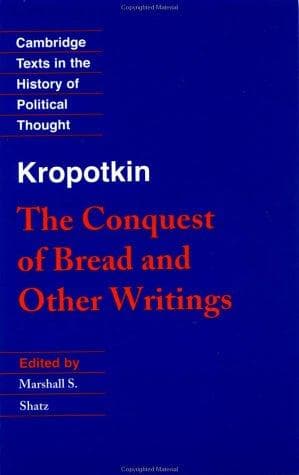
The Conquest of BreadKropotkin, Petr Alekseevich, kniaz
Philosophy
The Conquest of Bread
Kropotkin, Petr Alekseevich, kniaz
Anarchism; Communism
Collectivists begin by proclaiming a revolutionary principle--the
abolition of private property--and then they deny it, no sooner than
proclaimed, by upholding an organization of production and consumption
which originated in private property.
They proclaim a revolutionary principle, and ignore the consequences
that this principle will inevitably bring about. They forget that the
very fact of abolishing individual property in the instruments of
work--land, factories, road, capital--must launch society into
absolutely new channels; must completely overthrow the present system of
production, both in its aim as well as in its means; must modify daily
relations between individuals, as soon as land, machinery, and all other
instruments of production are considered common property.
They say, "No private property," and immediately after strive to
maintain private property in its daily manifestations. "You shall be a
Commune as far as regards production: fields, tools, machinery, all that
has been invented up till now--factories, railways, harbours, mines,
etc., all are yours. Not the slightest distinction will be made
concerning the share of each in this collective property.
"But from to-morrow you will minutely debate the share you are going to
take in the creation of new machinery, in the digging of new mines. You
will carefully weigh what part of the new produce belongs to you. You
will count your minutes of work, and you will take care that a minute of
your neighbours should not buy more than yours.
"And as an hour measures nothing, as in some factories a worker can see
to six power-looms at a time, while in another he only tends two, you
will weigh the muscular force, the brain energy, and the nervous energy
you have expended. You will accurately calculate the years of
apprenticeship in order to appraise the amount each will contribute to
future production. And this--after having declared that you do not take
into account his share in _past_ production."
Well, for us it is evident that a society cannot be based on two
absolutely opposed principles, two principles that contradict one
another continually. And a nation or a commune which would have such an
organization would be compelled to revert to private property in the
instruments of production, or to transform itself into a communist
society.
III
We have said that certain collectivist writers desire that a distinction
should be made between _qualified_ or professional work and _simple_
work. They pretend that an hour's work of an engineer, an architect, or
a doctor, must be considered as two or three hours' work of a
blacksmith, a mason, or a hospital nurse. And the same distinction must
be made between all sorts of trades necessitating apprenticeship, and
the simple toil of day labourers.
Public-domain text, read in full here on John Shaqi.
Reviews
Reviews
No reviews yet
Be the first to share your thoughts on this work.
Elsewhere in the archive
Join the Discussion
Join the discussion
Sign in to leave a comment or review.
Sign InorCreate an account