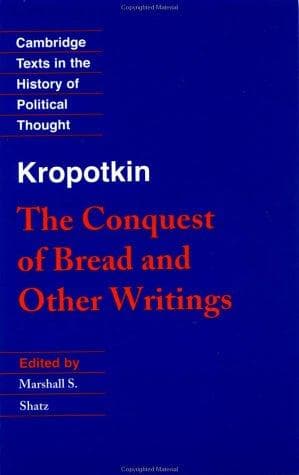
The Conquest of BreadKropotkin, Petr Alekseevich, kniaz
Philosophy
The Conquest of Bread
Kropotkin, Petr Alekseevich, kniaz
Anarchism; Communism
Well, to establish this distinction would be to maintain all the
inequalities of present society. It would mean fixing a dividing line,
from the beginning, between the workers and those who pretend to govern
them. It would mean dividing society into two very distinct classes--the
aristocracy of knowledge placed above the horny-handed lower orders--the
one doomed to serve the other; the one working with its hands to feed
and clothe those who, profiting by their leisure, study how to govern
their fosterers.
It would mean reviving one of the distinct peculiarities of present
society and giving it the sanction of the Social Revolution. It would
mean setting up as a principle an abuse already condemned in our ancient
crumbling society.
We know the answer we shall get. They will speak of "Scientific
Socialism"; they will quote bourgeois economists, and Marx too, to prove
that a scale of wages has its _raison d'être_, as "the labour force" of
the engineer will have cost more to society than the "labour-force" of
the navvy. In fact--have not economists tried to prove to us that if an
engineer is paid twenty times more than a navvy it is _because_ the
"necessary" outlay to make an engineer is greater than that necessary to
make a navvy? And has not Marx asserted that the same distinction is
equally logical between two branches of manual labour? He could not
conclude otherwise, having taken up on his own account Ricardo's theory
of value, and upheld that goods _are_ exchanged in proportion to the
quantity of work socially necessary for their production.
But we know what to think of this. We know that if engineers,
scientists, or doctors are paid ten or a hundred times more than a
labourer, and if a weaver earns three times more than an agricultural
labourer, and ten times more than a girl in a match factory, it is not
by reason of their "cost of production," but by reason of a monopoly of
education, or a monopoly of industry. Engineers, scientists, and doctors
merely exploit their capital--their diplomas--as middle-class employers
exploit a factory, or as nobles used to exploit their titles of
nobility.
As to the employer who pays an engineer twenty times more than a
labourer, it is simply due to personal interest; if the engineer can
economize £4,000 a year on the cost of production, the employer pays him
£800. And if the employer has a foreman who saves £400 on the work by
cleverly sweating workmen, he gladly gives him £80 or £120 a year. He
parts with an extra £40 when he expects to gain £400 by it; and this is
the essence of the Capitalist system. The same differences obtain among
different manual trades.
Public-domain text, read in full here on John Shaqi.
Reviews
Reviews
No reviews yet
Be the first to share your thoughts on this work.
Elsewhere in the archive
Join the Discussion
Join the discussion
Sign in to leave a comment or review.
Sign InorCreate an account