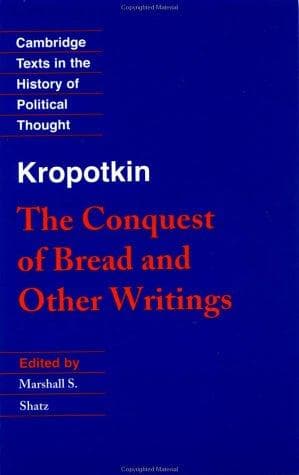
The Conquest of BreadKropotkin, Petr Alekseevich, kniaz
Philosophy
The Conquest of Bread
Kropotkin, Petr Alekseevich, kniaz
Anarchism; Communism
If you open the works of any economist you will find that he begins with
PRODUCTION, _i. e._, by the analysis of the means employed nowadays for
the creation of wealth: division of labour, the factory, its machinery,
the accumulation of capital. From Adam Smith to Marx, all have proceeded
along these lines. Only in the latter parts of their books do they treat
of CONSUMPTION, that is to say, of the means resorted to in our present
Society to satisfy the needs of the individuals; and even there they
confine themselves to explaining how riches _are_ divided among those
who vie with one another for their possession.
Perhaps you will say this is logical. Before satisfying needs you must
create the wherewithal to satisfy them. But, before producing anything,
must you not feel the need of it? Was it not necessity that first drove
man to hunt, to raise cattle, to cultivate land, to make implements, and
later on to invent machinery? Is it not the study of the needs that
should govern production? To say the least, it would therefore be quite
as logical to begin by considering the needs, and afterwards to discuss
how production is, and ought to be, organized, in order to satisfy these
needs.
This is precisely what we mean to do.
But as soon as we look at Political Economy from this point of view, it
entirely changes its aspect. It ceases to be a simple description of
facts, and becomes a _science_, and we may define this science as: "_The
study of the needs of mankind, and the means of satisfying them with the
least possible waste of human energy_". Its true name should be,
_Physiology of Society_. It constitutes a parallel science to the
physiology of plants and animals, which is the study of the needs of
plants and animals, and of the most advantageous ways of satisfying
them. In the series of sociological sciences, the economy of human
societies takes the place, occupied in the series of biological sciences
by the physiology of organic bodies.
We say, here are human beings, united in a society. All of them feel the
need of living in healthy houses. The savage's hut no longer satisfies
them; they require a more or less comfortable solid shelter. The
question is, then: whether, taking the present capacity of men for
production, every man can have a house of his own? and what is hindering
him from having it?
And as soon as we ask _this_ question, we see that every family in
Europe could perfectly well have a comfortable house, such as are built
in England, in Belgium, or in Pullman City, or else an equivalent set of
rooms. A certain number of days' work would suffice to build a pretty
little airy house, well fitted up and lighted by electricity.
Public-domain text, read in full here on John Shaqi.
Reviews
Reviews
No reviews yet
Be the first to share your thoughts on this work.
Elsewhere in the archive
Join the Discussion
Join the discussion
Sign in to leave a comment or review.
Sign InorCreate an account