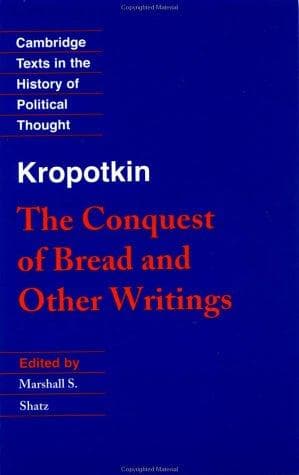
The Conquest of BreadKropotkin, Petr Alekseevich, kniaz
Philosophy
The Conquest of Bread
Kropotkin, Petr Alekseevich, kniaz
Anarchism; Communism
The 3,600,000 individuals who inhabit the two departments of Seine and
Seine-et-Oise consume yearly for their food a little less than 22
million bushels of cereals, chiefly wheat; and in our hypothesis they
would have to cultivate, in order to obtain this crop, 494,200 acres out
of the 1,507,300 acres which they possess. It is evident they would not
cultivate them with spades. That would need too much time--96 work-days
of 5 hours per acre. It would be preferable to improve the soil once for
all--to drain what needed draining, to level what needed levelling, to
clear the soil of stones, were it even necessary to spend 5 million days
of 5 hours in this preparatory work--an average of 10 work-days to each
acre.
Then they would plough with the steam-digger, which would take one and
three-fifths of a day per acre, and they would give another one and
three-fifths of a day for working with the double plough. Seeds would be
sorted by steam instead of taken haphazard, and they would be carefully
sown in rows instead of being thrown to the four winds. Now all this
work would not take 10 days of 5 hours per acre if the work were done
under good conditions. But if 10 million work-days are given to good
culture during 3 or 4 years, the result will be that later on crops of
44 to 55 bushels per acre will be obtained by only working half the
time.
Fifteen million work-days will thus have been spent to give bread to a
population of 3,600,000 inhabitants. And the work would be such that
everyone could do it without having muscles of steel, or without having
even worked the ground before. The initiative and the general
distribution of work would come from those who know the soil. As to the
work itself, there is no townsman of either sex so enfeebled as to be
incapable of looking after machines and of contributing his share to
agrarian work after a few hours' apprenticeship.
Well, when we consider that in the present chaos there are, in a city
like Paris, without counting the unemployed of the upper classes, there
are always about 100,000 workmen out of work in their several trades, we
see that the power lost in our present organization would alone suffice
to give, with a rational culture, all the bread that is necessary for
the three or four million inhabitants of the two departments.
We repeat, this is no fancy dream, and we have not yet spoken of the
truly intensive agriculture. We have not depended upon the wheat
(obtained in three years by Mr. Hallett) of which one grain, replanted,
produced 5,000 or 6,000, and occasionally 10,000 grains, which would
give the wheat necessary for a family of five individuals on an area of
120 square yards. On the contrary, we have only mentioned what is being
already achieved by numerous farmers in France, England, Belgium, etc.,
and what might be done to-morrow with the experience and knowledge
acquired already by practice on a large scale.
Public-domain text, read in full here on John Shaqi.
Reviews
Reviews
No reviews yet
Be the first to share your thoughts on this work.
Elsewhere in the archive
Join the Discussion
Join the discussion
Sign in to leave a comment or review.
Sign InorCreate an account