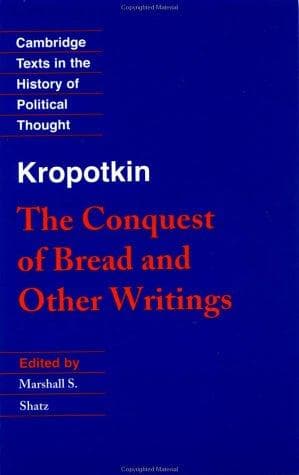
The Conquest of BreadKropotkin, Petr Alekseevich, kniaz
Philosophy
The Conquest of Bread
Kropotkin, Petr Alekseevich, kniaz
Anarchism; Communism
But over and above this we must take into account all the labour that
goes to sheer waste,--here, in keeping up the stables, the kennels, and
the retinue of the rich; there, in pandering to the caprices of society
and the depraved tastes of the fashionable mob; there again, in forcing
the consumer to buy what he does not need, or foisting an inferior
article upon him by means of puffery, and in producing on the other hand
wares which are absolutely injurious, but profitable to the
manufacturer. What is squandered in this manner would be enough to
double the production of useful things, or so to plenish our mills and
factories with machinery that they would soon flood the shops with all
that is now lacking to two-thirds of the nation. Under our present
system a full quarter of the producers in every nation are forced to be
idle for three or four months in the year, and the labour of another
quarter, if not of the half, has no better results than the amusement of
the rich or the exploitation of the public.
Thus, if we consider on the one hand the rapidity with which civilized
nations augment their powers of production, and on the other hand the
limits set to that production, be it directly or indirectly, by existing
conditions, we cannot but conclude that an economic system a trifle more
reasonable would permit them to heap up in a few years so many useful
products that they would be constrained to say--"Enough! We have enough
coal and bread and raiment! Let us rest and consider how best to use our
powers, how best to employ our leisure."
No, plenty for all is not a dream--though it was a dream indeed in those
days when man, for all his pains, could hardly win a few bushels of
wheat from an acre of land, and had to fashion by hand all the
implements he used in agriculture and industry. Now it is no longer a
dream, because man has invented a motor which, with a little iron and a
few sacks of coal, gives him the mastery of a creature strong and docile
as a horse, and capable of setting the most complicated machinery in
motion.
But, if plenty for all is to become a reality, this immense
capital--cities, houses, pastures, arable lands, factories, highways,
education--must cease to be regarded as private property, for the
monopolist to dispose of at his pleasure.
This rich endowment, painfully won, builded, fashioned, or invented by
our ancestors, must become common property, so that the collective
interests of men may gain from it the greatest good for all.
There must be EXPROPRIATION. The well-being of all--the end;
expropriation--the means.
II
Expropriation, such then is the problem which History has put before the
men of the twentieth century: the return to Communism in all that
ministers to the well-being of man.
Public-domain text, read in full here on John Shaqi.
Reviews
Reviews
No reviews yet
Be the first to share your thoughts on this work.
Join the Discussion
Join the discussion
Sign in to leave a comment or review.
Sign InorCreate an account