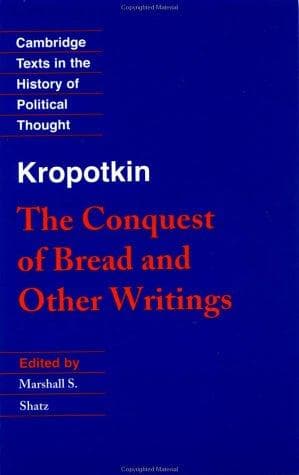
The Conquest of BreadKropotkin, Petr Alekseevich, kniaz
Philosophy
The Conquest of Bread
Kropotkin, Petr Alekseevich, kniaz
Anarchism; Communism
All this may please those who like the stage, but it is not revolution.
Nothing has been accomplished as yet.
And meanwhile the people suffer. The factories are idle, the workshops
closed; trade is at a standstill. The worker does not even earn the
meagre wage which was his before. Food goes up in price. With that
heroic devotion which has always characterized them, and which in great
crises reaches the sublime, the people will wait patiently. "We place
these three months of want at the service of the Republic," they said in
1848, while "their representatives" and the gentlemen of the new
Government, down to the meanest Jack-in-office received their salary
regularly.
The people suffer. With the childlike faith, with the good humour of the
masses who believe in their leaders, they think that "yonder," in the
House, in the Town Hall, in the Committee of Public Safety, their
welfare is being considered. But "yonder" they are discussing everything
under the sun except the welfare of the people. In 1793, while famine
ravaged France and crippled the Revolution; whilst the people were
reduced to the depths of misery, although the Champs Elysées were lined
with luxurious carriages where women displayed their jewels and
splendour, Robespierre was urging the Jacobins to discuss his treatise
on the English Constitution. While the worker was suffering in 1848 from
the general stoppage of trade, the Provisional Government and the
National Assembly were wrangling over military pensions and prison
labour, without troubling how the people managed to live during the
terrible crisis. And could one cast a reproach at the Paris Commune,
which was born beneath the Prussian cannon, and lasted only seventy
days, it would be for this same error--this failure to understand that
the Revolution could not triumph unless those who fought on its side
were fed: that on fifteen pence a day a man cannot fight on the ramparts
and at the same time support a family.
The people will suffer and say: "How is a way out of these difficulties
to be found?"
III
It seems to us that there is only one answer to this question: We must
recognize, and loudly proclaim, that every one, whatever his grade in
the old society, whether strong or weak, capable or incapable, has,
before everything, THE RIGHT TO LIVE, and that society is bound to share
amongst all, without exception, the means of existence it has at its
disposal. We must acknowledge this, and proclaim it aloud, and act up to
it.
Public-domain text, read in full here on John Shaqi.
Reviews
Reviews
No reviews yet
Be the first to share your thoughts on this work.
Join the Discussion
Join the discussion
Sign in to leave a comment or review.
Sign InorCreate an account