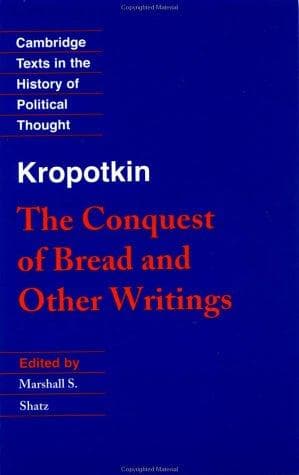
The Conquest of BreadKropotkin, Petr Alekseevich, kniaz
Philosophy
The Conquest of Bread
Kropotkin, Petr Alekseevich, kniaz
Anarchism; Communism
How then, shall we estimate the share of each in the riches which ALL
contribute to amass?
Looking at production from this general, synthetic point of view, we
cannot hold with the Collectivists that payment proportionate to the
hours of labour rendered by each would be an ideal arrangement, or even
a step in the right direction.
Without discussing whether exchange value of goods is really measured in
existing societies by the amount of work necessary to produce
it--according to the teaching of Adam Smith and Ricardo, in whose
footsteps Marx has followed--suffice it to say here, leaving ourselves
free to return to the subject later, that the Collectivist ideal appears
to us untenable in a society which considers the instruments of labour
as a common inheritance. Starting from this principle, such a society
would find itself forced from the very outset to abandon all forms of
wages.
The migrated individualism of the Collectivist system certainly could
not maintain itself alongside a partial communism--the socialization of
land and the instruments of production. A new form of property requires
a new form of remuneration. A new method of production cannot exist side
by side with the old forms of consumption, any more than it can adapt
itself to the old forms of political organization.
The wage system arises out of the individual ownership of the land and
the instruments of labour. It was the necessary condition for the
development of capitalist production, and will perish with it, in spite
of the attempt to disguise it as "profit-sharing." The common
possession of the instruments of labour must necessarily bring with it
the enjoyment in common of the fruits of common labour.
We hold further that Communism is not only desirable, but that existing
societies, founded on Individualism, _are inevitably impelled in the
direction of Communism_. The development of Individualism during the
last three centuries is explained by the efforts of the individual to
protect himself from the tyranny of Capital and of the State. For a time
he imagined, and those who expressed his thought for him declared, that
he could free himself entirely from the State and from society. "By
means of money," he said, "I can buy all that I need." But the
individual was on a wrong track, and modern history has taught him to
recognize that, without the help of all, he can do nothing, although his
strong-boxes are full of gold.
In fact, along this current of Individualism, we find in all modern
history a tendency, on the one hand to retain all that remains of the
partial Communism of antiquity, and, on the other, to establish the
Communist principle in the thousand developments of modern life.
Public-domain text, read in full here on John Shaqi.
Reviews
Reviews
No reviews yet
Be the first to share your thoughts on this work.
Join the Discussion
Join the discussion
Sign in to leave a comment or review.
Sign InorCreate an account