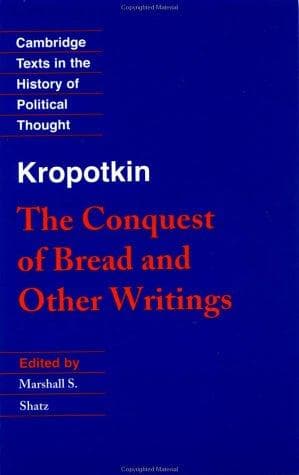
The Conquest of BreadKropotkin, Petr Alekseevich, kniaz
Philosophy
The Conquest of Bread
Kropotkin, Petr Alekseevich, kniaz
Anarchism; Communism
These conditions, which began to appear by the end of the eighteenth
century, took, however, their full development in the nineteenth century
only, after the Napoleonic wars came to an end. And modern Communism has
to take them into account.
It is now known that the French Revolution, apart from its political
significance, was an attempt made by the French people, in 1793 and
1794, in three different directions more or less akin to Socialism. It
was, first, _the equalization of fortunes_, by means of an income tax
and succession duties, both heavily progressive, as also by a direct
confiscation of the land in order to sub-divide it, and by heavy war
taxes levied upon the rich only. The second attempt was a sort of
_Municipal Communism_ as regards the consumption of some objects of
first necessity, bought by the municipalities, and sold by them at cost
price. And the third attempt was to introduce a wide _national system of
rationally established prices of all commodities_, for which the real
cost of production and moderate trade profits had to be taken into
account. The Convention worked hard at this scheme, and had nearly
completed its work, when reaction took the upper hand.
It was during this remarkable movement, which has never yet been
properly studied, that modern Socialism was born--Fourierism with
L'Ange, at Lyons, and authoritarian Communism with Buonarroti, Babeuf,
and their comrades. And it was immediately after the Great Revolution
that the three great theoretical founders of modern Socialism--Fourier,
Saint Simon, and Robert Owen, as well as Godwin (the No-State
Socialism)--came forward; while the secret communist societies,
originated from those of Buonarroti and Babeuf, gave their stamp to
militant, authoritarian Communism for the next fifty years.
To be correct, then, we must say that modern Socialism is not yet a
hundred years old, and that, for the first half of these hundred years,
two nations only, which stood at the head of the industrial movement,
i.e., Britain and France, took part in its elaboration. Both--bleeding
at that time from the terrible wounds inflicted upon them by fifteen
years of Napoleonic wars, and both enveloped in the great European
reaction that had come from the East.
In fact, it was only after the Revolution of July, 1830, in France, and
the Reform movement of 1830-1832 in this country, had begun to shake off
that terrible reaction, that the discussion of Socialism became possible
for a few years before the revolution of 1848. And it was during those
years that the aspirations of Fourier, St. Simon, and Robert Owen,
worked out by their followers, took a definite shape, and the different
schools of Socialism which exist nowadays were defined.
Public-domain text, read in full here on John Shaqi.
Reviews
Reviews
No reviews yet
Be the first to share your thoughts on this work.
Join the Discussion
Join the discussion
Sign in to leave a comment or review.
Sign InorCreate an account