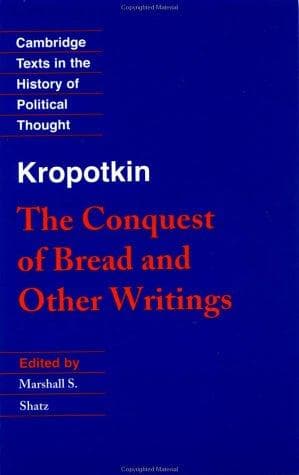
The Conquest of BreadKropotkin, Petr Alekseevich, kniaz
Philosophy
The Conquest of Bread
Kropotkin, Petr Alekseevich, kniaz
Anarchism; Communism
The history of the last fifty years furnishes a living proof that
Representative Government is impotent to discharge all the functions we
have sought to assign to it. In days to come the nineteenth century will
be quoted as having witnessed the failure of parliamentarianism.
This impotence is becoming so evident to all; the faults of
parliamentarianism, and the inherent vices of the representative
principle, are so self-evident, that the few thinkers who have made a
critical study of them (J. S. Mill, Leverdays), did but give literary
form to the popular dissatisfaction. It is not difficult, indeed, to see
the absurdity of naming a few men and saying to them, "Make laws
regulating all our spheres of activity, although not one of you knows
anything about them!"
We are beginning to see that government by majorities means abandoning
all the affairs of the country to the tide-waiters who make up the
majorities in the House and in election committees; to those, in a word,
who have no opinion of their own.
Mankind is seeking and already finding new issues. The International
Postal Union, the railway unions, and the learned societies give us
examples of solutions based on free agreement in place and stead of law.
To-day, when groups scattered far and wide wish to organize themselves
for some object or other, they no longer elect an international
parliament of Jacks-of-all-trades. They proceed in a different way.
Where it is not possible to meet directly or come to an agreement by
correspondence, delegates versed in the question at issue are sent, and
they are told: "Endeavour to come to an agreement on such or such a
question, and then return, not with a law in your pocket, but with a
proposition of agreement which we may or may not accept."
Such is the method of the great industrial companies, the learned
societies, and numerous associations of every description, which already
cover Europe and the United States. And such will be the method of a
free society. A society founded on serfdom is in keeping with absolute
monarchy; a society based on the wage system and the exploitation of the
masses by the capitalists finds its political expression in
parliamentarianism. But a free society, regaining possession of the
common inheritance, must seek in free groups and free federations of
groups, a new organization, in harmony with the new economic phase of
history.
Every economic phase has a political phase corresponding to it, and it
would be impossible to touch private property unless a new mode of
political life be found at the same time.
CHAPTER IV
EXPROPRIATION
I
Public-domain text, read in full here on John Shaqi.
Reviews
Reviews
No reviews yet
Be the first to share your thoughts on this work.
Join the Discussion
Join the discussion
Sign in to leave a comment or review.
Sign InorCreate an account