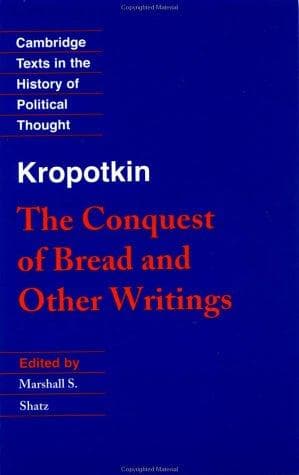
The Conquest of BreadKropotkin, Petr Alekseevich, kniaz
Philosophy
The Conquest of Bread
Kropotkin, Petr Alekseevich, kniaz
Anarchism; Communism
Or, finally, suppose you oust the landowners, and hand over the mills
and factories to the worker, without interfering with the swarm of
middlemen who drain the product of our manufacturers, and speculate in
corn and flour, meat and groceries, in our great centres of commerce.
Then, as soon as the exchange of produce is slackened; as soon as the
great cities are left without bread, while the great manufacturing
centres find no buyers for the articles of luxury they produce,--the
counter-revolution is bound to take place, and it would come, treading
upon the slain, sweeping the towns and villages with shot and shell;
indulging in orgies of proscriptions and deportations, such as were seen
in France in 1815, 1848, and 1871.
All is interdependent in a civilized society; it is impossible to reform
any one thing without altering the whole. Therefore, on the day a nation
will strike at private property, under any one of its forms, territorial
or industrial, it will be obliged to attack them all. The very success
of the Revolution will impose it.
Besides, even if it were desired, it would be impossible to confine the
change to a partial expropriation. Once the principle of the "Divine
Right of Property" is shaken, no amount of theorizing will prevent its
overthrow, here by the slaves of the field, there by the slaves of the
machine.
If a great town, Paris for example, were to confine itself to taking
possession of the dwelling houses of the factories, it would be forced
also to deny the right of the bankers to levy upon the Commune a tax
amounting to £2,000,000, in the form of interest for former loans. The
great city would be obliged to put itself in touch with the rural
districts, and its influence would inevitably urge the peasants to free
themselves from the landowner. It would be necessary to communalize the
railways, that the citizens might get food and work, and lastly, to
prevent the waste of supplies; and to guard against the trusts of
corn-speculators, like those to whom the Paris Commune of 1793 fell a
prey, it would have to place in the hands of the City the work of
stocking its warehouses with commodities, and apportioning the produce.
Some Socialists still seek, however, to establish a distinction. "Of
course," they say, "the soil, the mines, the mills, and manufacturers
must be expropriated, these are the instruments of production, and it is
right we should consider them public property. But articles of
consumption--food, clothes, and dwellings--should remain private
property."
Public-domain text, read in full here on John Shaqi.
Reviews
Reviews
No reviews yet
Be the first to share your thoughts on this work.
Join the Discussion
Join the discussion
Sign in to leave a comment or review.
Sign InorCreate an account