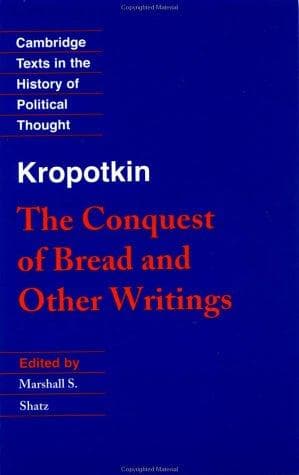
The Conquest of BreadKropotkin, Petr Alekseevich, kniaz
Philosophy
The Conquest of Bread
Kropotkin, Petr Alekseevich, kniaz
Anarchism; Communism
In each case the people strove to overturn the old regime, and spent
their heart's blood for the cause. Then, after having borne the brunt of
the battle, they sank again into obscurity. A Government, composed of
men more or less honest, was formed and undertook to organize a new
regime: the Republic in 1793, Labour in 1848, the Free Commune in 1871.
Imbued with Jacobin ideas, this Government occupied itself first of all
with political questions, such as the reorganization of the machinery of
government, the purifying of the administration, the separation of
Church and State, civic liberty, and such matters. It is true the
workmen's clubs kept an eye on the members of the new Government, and
often imposed their ideas on them. But even in these clubs, whether the
leaders belonged to the middle or the working classes, it was always
middle-class ideas which prevailed. They discussed various political
questions at great length, but forgot to discuss the question of bread.
Great ideas sprang up at such times, ideas that have moved the world;
words were spoken which still stir our hearts, at the interval of more
than a century. But the people were starving in the slums.
From the very Commencement of the Revolution industry inevitably came to
a stop--the circulation of produce was checked, and capital concealed
itself. The master--the employer--had nothing to fear at such times, he
fattened on his dividends, if indeed he did not speculate on the
wretchedness around; but the wage-earner was reduced to live from hand
to mouth. Want knocked at the door.
Famine was abroad in the land--such famine as had hardly been seen under
the old regime.
"The Girondists are starving us!" was the cry in the workmen's quarters
in 1793, and thereupon the Girondists were guillotined, and full powers
were given to "the Mountain" and to the Commune. The Commune indeed
concerned itself with the question of bread, and made heroic efforts to
feed Paris. At Lyons, Fouché and Collot d'Herbois established city
granaries, but the sums spent on filling them were woefully
insufficient. The town councils made great efforts to procure corn; the
bakers who hoarded flour were hanged--and still the people lacked bread.
Then they turned on the royalist conspirators and laid the blame at
their door. They guillotined a dozen or fifteen a day--servants and
duchesses alike, especially servants, for the duchesses had gone to
Coblentz. But if they had guillotined a hundred dukes and viscounts
every day, it would have been equally hopeless.
The want only grew. For the wage-earner cannot live without his wage,
and the wage was not forthcoming. What difference could a thousand
corpses more or less make to him?
Public-domain text, read in full here on John Shaqi.
Reviews
Reviews
No reviews yet
Be the first to share your thoughts on this work.
Join the Discussion
Join the discussion
Sign in to leave a comment or review.
Sign InorCreate an account