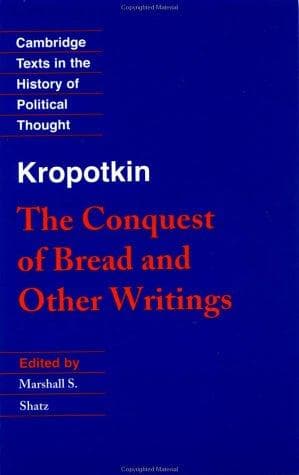
The Conquest of BreadKropotkin, Petr Alekseevich, kniaz
Philosophy
The Conquest of Bread
Kropotkin, Petr Alekseevich, kniaz
Anarchism; Communism
But when there will be no more starvelings ready to sell their work for
a pittance, when the exploited worker of to-day will be educated, and
will have his _own_ ideas to put down in black and white and to
communicate to others, then the authors and scientific men will be
compelled to combine among themselves and with the printers, in order to
bring out their prose and their poetry.
So long as men consider fustian and manual labour a mark of inferiority,
it will appear amazing to them to see an author setting up his own book
in type, for has he not a gymnasium or games by way of diversion? But
when the opprobrium connected with manual labor has disappeared, when
all will have to work with their hands, there being no one to do it for
them, then the authors as well as their admirers will soon learn the art
of handling composing-sticks and type; they will know the pleasure of
coming together--all admirers of the work to be printed--to set up the
type, to shape it into pages, to take it in its virginal purity from the
press. These beautiful machines, instruments of torture to the child who
attends on them from morn till night, will be a source of enjoyment for
those who will make use of them in order to give voice to the thoughts
of their favourite author.
Will literature lose by it? Will the poet be less a poet after having
worked out of doors or helped with his hands to multiply his work? Will
the novelist lose his knowledge of human nature after having rubbed
shoulders with other men in the forest or the factory, in the laying out
of a road or on a railway line? Can there be two answers to these
questions?
Maybe some books will be less voluminous; but then, more will be said on
fewer pages. Maybe fewer waste-sheets will be published; but the matter
printed will be more attentively read and more appreciated. The book
will appeal to a larger circle of better educated readers, who will be
more competent to judge.
Moreover, the art of printing, that has so little progressed since
Gutenberg, is still in its infancy. It takes two hours to compose in
type what is written in ten minutes, but more expeditious methods of
multiplying thought are being sought after and will be discovered.[6]
What a pity every author does not have to take his share in the printing
of his works! What progress printing would have already made! We should
no longer be using movable letters, as in the seventeenth century.
III
Public-domain text, read in full here on John Shaqi.
Reviews
Reviews
No reviews yet
Be the first to share your thoughts on this work.
Elsewhere in the archive
Join the Discussion
Join the discussion
Sign in to leave a comment or review.
Sign InorCreate an account