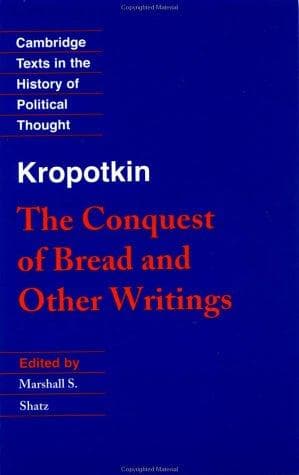
The Conquest of BreadKropotkin, Petr Alekseevich, kniaz
Philosophy
The Conquest of Bread
Kropotkin, Petr Alekseevich, kniaz
Anarchism; Communism
Is it a dream to conceive a society in which--all having become
producers, all having received an education that enables them to
cultivate science or art, and all having leisure to do so--men would
combine to publish the works of their choice, by contributing each his
share of manual work? We have already hundreds of learned, literary, and
other societies; and these societies are nothing but voluntary groups of
men, interested in certain branches of learning, and associated for the
purpose of publishing their works. The authors who write for the
periodicals of these societies are not paid, and the periodicals, apart
from a limited number of copies, are not for sale; they are sent gratis
to all quarters of the globe, to other societies, cultivating the same
branches of learning. This member of the Society may insert in its
review a one-page note summarizing his observations; another may publish
therein an extensive work, the results of long years of study; while
others will confine themselves to consulting the review as a
starting-point for further research. It does not matter: all these
authors and readers are associated for the production of works in which
all of them take an interest.
It is true that a learned society, like the individual author, goes to a
printing office where workmen are engaged to do the printing. Nowadays,
those who belong to the learned societies despise manual labour which
indeed is carried on under very bad conditions; but a community which
would give a generous philosophic and _scientific_ education to all its
members, would know how to organize manual labour in such a way that it
would be the pride of humanity. Its learned societies would become
associations of explorers, lovers of science, and workers--all knowing a
manual trade and all interested in science.
If, for example, the Society is studying geology, all will contribute to
the exploration of the earth's strata; each member will take his share
in research, and ten thousand observers, where we have now only a
hundred, will do more in a year than we can do in twenty years. And when
their works are to be published, ten thousand men and women, skilled in
different trades, will be ready to draw maps, engrave designs, compose,
and print the books. With gladness will they give their leisure--in
summer to exploration, in winter to indoor work. And when their works
appear, they will find not only a hundred, but ten thousand readers
interested in their common work.
Public-domain text, read in full here on John Shaqi.
Reviews
Reviews
No reviews yet
Be the first to share your thoughts on this work.
Elsewhere in the archive
Join the Discussion
Join the discussion
Sign in to leave a comment or review.
Sign InorCreate an account