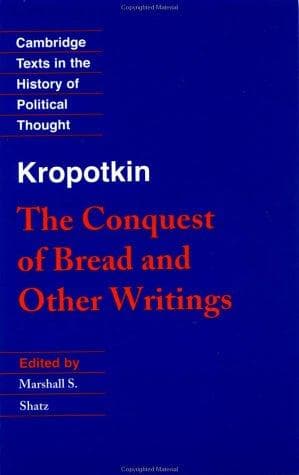
The Conquest of BreadKropotkin, Petr Alekseevich, kniaz
Philosophy
The Conquest of Bread
Kropotkin, Petr Alekseevich, kniaz
Anarchism; Communism
During the long succession of agitated ages which have elapsed since,
mankind has nevertheless amassed untold treasures. It has cleared the
land, dried the marshes, hewn down forests, made roads, pierced
mountains; it has been building, inventing, observing, reasoning; it has
created a complex machinery, wrested her secrets from Nature, and
finally it pressed steam and electricity into its service. And the
result is, that now the child of the civilized man finds at its birth,
ready for its use, an immense capital accumulated by those who have gone
before him. And this capital enables man to acquire, merely by his own
labour combined with the labour of others, riches surpassing the dreams
of the fairy tales of the Thousand and One Nights.
The soil is cleared to a great extent, fit for the reception of the best
seeds, ready to give a rich return for the skill and labour spent upon
it--a return more than sufficient for all the wants of humanity. The
methods of rational cultivation are known.
On the wide prairies of America each hundred men, with the aid of
powerful machinery, can produce in a few months enough wheat to maintain
ten thousand people for a whole year. And where man wishes to double his
produce, to treble it, to multiply it a hundred-fold, he _makes_ the
soil, gives to each plant the requisite care, and thus obtains enormous
returns. While the hunter of old had to scour fifty or sixty square
miles to find food for his family, the civilized man supports his
household, with far less pains, and far more certainty, on a thousandth
part of that space. Climate is no longer an obstacle. When the sun
fails, man replaces it by artificial heat; and we see the coming of a
time when artificial light also will be used to stimulate vegetation.
Meanwhile, by the use of glass and hot water pipes, man renders a given
space ten and fifty times more productive than it was in its natural
state.
The prodigies accomplished in industry are still more striking. With the
co-operation of those intelligent beings, modern machines--themselves
the fruit of three or four generations of inventors, mostly unknown--a
hundred men manufacture now the stuff to provide ten thousand persons
with clothing for two years. In well-managed coal mines the labour of a
hundred miners furnishes each year enough fuel to warm ten thousand
families under an inclement sky. And we have lately witnessed the
spectacle of wonderful cities springing up in a few months for
international exhibitions, without interrupting in the slightest degree
the regular work of the nations.
And if in manufactures as in agriculture, and as indeed through our
whole social system, the labour, the discoveries, and the inventions of
our ancestors profit chiefly the few, it is none the less certain that
mankind in general, aided by the creatures of steel and iron which it
already possesses, could already procure an existence of wealth and ease
for every one of its members.
Public-domain text, read in full here on John Shaqi.
Reviews
Reviews
No reviews yet
Be the first to share your thoughts on this work.
Join the Discussion
Join the discussion
Sign in to leave a comment or review.
Sign InorCreate an account