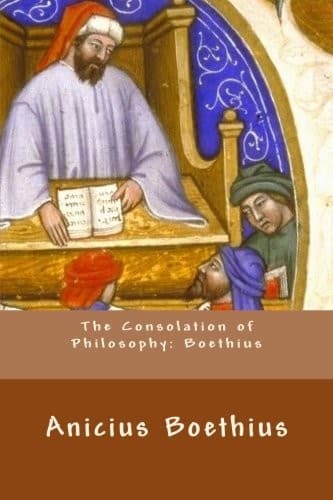
Anicus Manlius Severinus Boethius lived in the last quarter of the fifth
century A.D., and the first quarter of the sixth. He was growing to
manhood, when Theodoric, the famous Ostrogoth, crossed the Alps and made
himself master of Italy. Boethius belonged to an ancient family, which
boasted a connection with the legendary glories of the Republic, and was
still among the foremost in wealth and dignity in the days of Rome's
abasement. His parents dying early, he was brought up by Symmachus, whom
the age agreed to regard as of almost saintly character, and afterwards
became his son-in-law. His varied gifts, aided by an excellent
education, won for him the reputation of the most accomplished man of
his time. He was orator, poet, musician, philosopher. It is his peculiar
distinction to have handed on to the Middle Ages the tradition of Greek
philosophy by his Latin translations of the works of Aristotle. Called
early to a public career, the highest honours of the State came to him
unsought. He was sole Consul in 510 A.D., and was ultimately raised by
Theodoric to the dignity of Magister Officiorum, or head of the whole
civil administration. He was no less happy in his domestic life, in the
virtues of his wife, Rusticiana, and the fair promise of his two sons,
Symmachus and Boethius; happy also in the society of a refined circle of
friends. Noble, wealthy, accomplished, universally esteemed for his
virtues, high in the favour of the Gothic King, he appeared to all men a
signal example of the union of merit and good fortune. His felicity
seemed to culminate in the year 522 A.D., when, by special and
extraordinary favour, his two sons, young as they were for so exalted an
honour, were created joint Consuls and rode to the senate-house
attended by a throng of senators, and the acclamations of the multitude.
Boethius himself, amid the general applause, delivered the public speech
in the King's honour usual on such occasions. Within a year he was a
solitary prisoner at Pavia, stripped of honours, wealth, and friends,
with death hanging over him, and a terror worse than death, in the fear
lest those dearest to him should be involved in the worst results of his
downfall. It is in this situation that the opening of the 'Consolation
of Philosophy' brings Boethius before us. He represents himself as
seated in his prison distraught with grief, indignant at the injustice
of his misfortunes, and seeking relief for his melancholy in writing
verses descriptive of his condition. Suddenly there appears to him the
Divine figure of Philosophy, in the guise of a woman of superhuman
dignity and beauty, who by a succession of discourses convinces him of
the vanity of regret for the lost gifts of fortune, raises his mind once
more to the contemplation of the true good, and makes clear to him the
mystery of the world's moral government.
INDEX
OF
VERSE INTERLUDES.
BOOK I.
THE SORROWS OF BOETHIUS.
Public-domain text, read in full here on John Shaqi.
Reviews
Reviews
No reviews yet
Be the first to share your thoughts on this work.
Join the Discussion
Join the discussion
Sign in to leave a comment or review.
Sign InorCreate an account