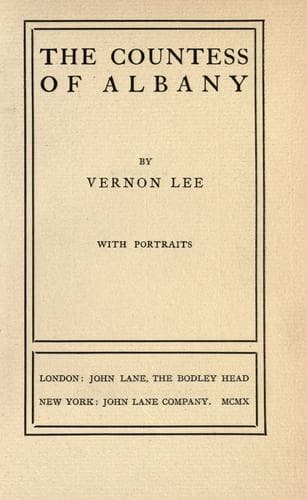
Albany, Louise Maximiliane Caroline Emanuele, Princess of Stolberg-Gedern, calling herself Countess of, 1752-1824
Alfieri had always had what, to us, may seem very strange notions on the
subject of love, but which were not strange when we consider the times
and nation in general, and the man in particular. After the various
love manias which preceded his meeting with Mme. d'Albany, he had
determined, as he tells us, to save his peace of mind and dignity by
refusing to fall in love with women of respectable position. The
Countess of Albany, by enchaining him in the bonds of what he called
"worthy love," had saved him from any chance of fresh follies with these
alarming "virtuous women." But follies with women of less respectable
position and less obvious virtue appear to have presented no fear of
degradation to Alfieri's mind. And now, late on in the nineties, when
Mme. d'Albany was rapidly growing plain and stout and elderly, and he
was getting into the systematic habit of regarding her less in her
reality than in the ideal image which he had arranged in his mind; now,
when he was writing the autobiography where the Countess figured as
his Beatrice, and when he was composing the Latin epitaphs which were
to unite his tomb with that of the woman "a Victorio Alferio, ultra
resomnia dilecta," just at this time Alfieri appears to have returned to
those flirtations with women neither respectable nor virtuous which
seemed to him so morally safe to indulge in. A very strange note,
preserved at Siena, to a "Nina padrona mia dilettissima," shows that the
memory of Gori and the friendship of Gori's friends were not the only
things which attracted him ever and anon from Florence to Siena. A
collection of wretched bouts-rimes and burlesque doggrel, written at
Florence in a house which Mme. d'Albany could not enter, and in the
company of women whom Mme. d'Albany could not receive, and among which
is a sonnet in which Alfieri explains his condescension in joining in
these poetical exercises of the demi-monde by an allusion to Hercules
and Omphale, shows that Alfieri frequented in Florence other society
besides that which crowded round his lady in Casa Gianfigliazzi.
Public-domain text, read in full here on John Shaqi.
Reviews
Reviews
No reviews yet
Be the first to share your thoughts on this work.
Elsewhere in the archive
Join the Discussion
Join the discussion
Sign in to leave a comment or review.
Sign InorCreate an account