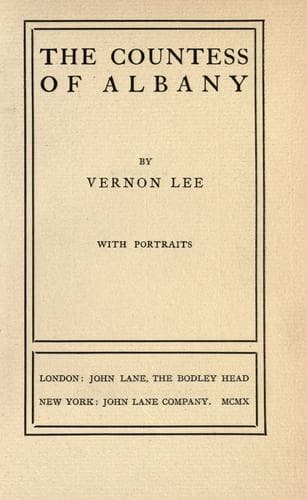
Albany, Louise Maximiliane Caroline Emanuele, Princess of Stolberg-Gedern, calling herself Countess of, 1752-1824
Mme. d'Albany was far too shrewd and far too worldly not to see all
this; and Alfieri was far too open and cynical to attempt to hide
it. Mme. d'Albany, having her praises and his love read to her in
innumerable sonnets, in the autobiography and in the epitaphs, probably
merely smiled; she was a woman of the eighteenth century, a foreigner,
an easy-going woman, and had learned to consider such escapades as these
as an inevitable part of matrimony or quasi-matrimony. But, for all her
worldly philosophy, did she never feel a vague craving, a void, as she
sat in that big empty house reading her books while Alfieri was studying
his Greek, a vague desire to have what consoles other women for coldness
or infidelity, a son or a daughter, a normal object of devotion, something
besides Alfieri, and which she could love whether deserving or not;
something besides Alfieri's glory, in which she could take an interest
whether other people did or did not agree? Such a connection as hers
with Alfieri may have had an attraction of romance, of poetry, connected
with its very illegitimacy, its very negation of normal domestic life,
as long as both she and Alfieri were young and passionately in love; but
where was the romance, the poetry now, and where was the humdrum married
woman's happiness, at whose expense that romance, that poetry, had been
bought?
Mme. d'Albany, if I may judge by the enormous piles of her letters which
I have myself seen, and by the report of my friend Signor Mario Pratesi,
who has examined another huge collection for my benefit, was getting to
make herself a sort of half-vegetating intellectual life, reading so
many hours a day, writing letters so many more hours; taking the quite
unenthusiastic, business-like interest in literature and politics of a
woman whose life is very empty, and, it seems to me, from the tone of
her letters, growing daily more indifferent to life, more desultory,
more cynical, more misanthropic and tittle-tattling. And Alfieri,
meanwhile, was growing more unsociable, more misanthropic, more violent
in temper, hanging a printed card stating that he wished no visits (one
such is preserved in the library at Florence) in the hall, pursuing and
flogging street-boys because they splashed his stockings by playing in
the puddles; insulting Ginguene and General Miollis when they attempted
to be civil; groaning over the victories of the French, rejoicing over
the brutal massacres by the priest-hounded Tuscan populace; going to
Florence (when they were spending the summer in a villa) for the
pleasure of seeing the Austrian troops enter, and of witnessing (as Gino
Capponi records) the French prisoners or Frenchly-inclined Florentines
being pilloried and tortured by the anti-revolutionary mob. Besides such
demonstrations of an unamiable disposition as these, working with the
fury of an alchemist, and, perhaps, taking a holiday at that house where
the doggrel verses were written. The Countess of Albany, who had been so
Public-domain text, read in full here on John Shaqi.
Reviews
Reviews
No reviews yet
Be the first to share your thoughts on this work.
Elsewhere in the archive
Join the Discussion
Join the discussion
Sign in to leave a comment or review.
Sign InorCreate an account