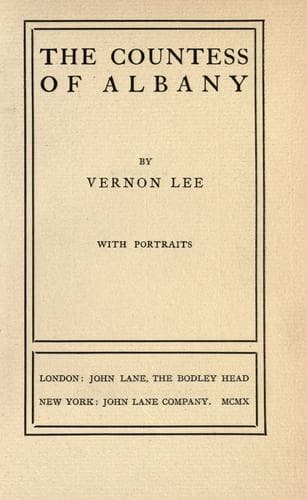
Albany, Louise Maximiliane Caroline Emanuele, Princess of Stolberg-Gedern, calling herself Countess of, 1752-1824
A ridiculous man! Not so. I have spoken many hard words against Alfieri;
and I repeat that he seems to me to have often fallen short, betrayed by
his century, his vanity, his narrowness and hardness of temper, even of
the ideal which he had set up for himself. But I would not have it
supposed that I do not see the greatness of that ideal, and the nobleness
of the reality out of which it arose. That Alfieri, a strange mixture of
the passionate man of spontaneous action, and of the self-manipulating,
idealising _poseur_, should have fallen short of his own ideals, is
perhaps the one pathetic circumstance of his life; the one dash of
suffering and failure which makes this heroic man a hero. Alfieri did
not probably suspect wherein he fell short of his own ideal; he did
not, could not see that his faults were narrowness of nature, and
incompleteness, meanness of conception, for, if he had, he would have
ceased to be narrow and ceased to be mean. But Alfieri knew that there
was something very wrong about himself, he felt a deficiency, a jar in
his own soul; he felt, as he describes in the famous sonnet at the back
of Fabre's portrait of him, that he did not know whether he was noble or
base, whether he was Achilles or Thersites.
"_Uom, sei tu grande o vile? Mori, il saprai._" ("Man, art thou noble
or base? Die, and thou shalt know it.") Thus wrote Alfieri, making, as
usual, fame the arbiter of his worth; and showing, even in the moment of
seeking for truth about himself, how utterly and hopelessly impossible
it was for him to feel it. Mean and great; both, I think, at once. But
of the meanness, the narrowness of nature, the want of resonance of
fibre, the insufficiency of moral vitality in so many things; of
Alfieri's vanity, intolerance, injustice, indifference, hardness; of all
these peculiarities which make the real man repulsive, the ideal man
unattractive, to us, I have said more than enough, and when we have
said all this, Alfieri still remains, for all his vanity, selfishness,
meanness, narrow-mindedness, a man of grander proportions, of finer
materials, nay, even of nobler moral shape, than the vast majority of
men superior to him in all these points. Let us look at him in those
last decaying years, at those studies which have seemed to us absurd:
self-important, pedantic, almost monomaniac; or brooding over those
feelings which were, doubtless, selfish, morbid; let us look at him,
for, despite all his faults, he is fine. Fine in indomitable energy, in
irrepressible passion. Alfieri was fifty; he was tormented by gout; his
health was rapidly sinking; but the sense of weakness only made him more
resolute to finish the work which (however mistakenly) he thought it his
duty to leave completed; more determined that, having lived for so many
years a dunce, he would go down to the grave cleansed of the stain of
ignorance, having read and appreciated as much of the great writers of
antiquity as any man who had had a well-trained youth, a studious
Public-domain text, read in full here on John Shaqi.
Reviews
Reviews
No reviews yet
Be the first to share your thoughts on this work.
Elsewhere in the archive
Join the Discussion
Join the discussion
Sign in to leave a comment or review.
Sign InorCreate an account