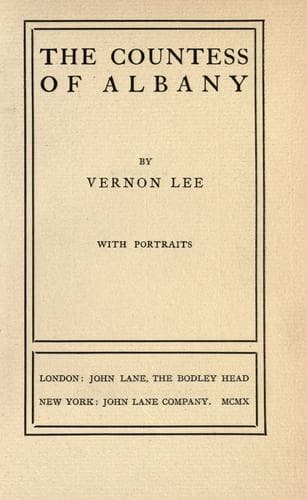
Albany, Louise Maximiliane Caroline Emanuele, Princess of Stolberg-Gedern, calling herself Countess of, 1752-1824
manhood. Soon after his great illness (which, I believe, changed him so
much for the worse by hastening premature old age) at Colmar, he had
written to his friends at Siena that he had very nearly been made a fool
of by Death; but that, having escaped, he intended, by hurrying his
work, to make a fool of Death instead. And in 1801 he wrote in his
memorandum-book: "Health giving way year by year; whence, hurrying to
finish my six comedies, I make it decidedly worse."
Soon after, as Mme. d'Albany later informed his friend Caluso, Alfieri,
finding that his digestion had become so bad as to produce inability to
work after meals, began systematically to diminish his already extremely
sober allowance of food; while, at the same time, he did not diminish
the exercise, walking, riding, and driving, which he found necessary to
keep himself in spirits. Knowing that death could not be far ahead, and
accustomed since his youth to think that his life ought not to extend
over sixty years, Alfieri was calmly and deliberately walking to meet
Death.
Calmly and deliberately; but not heartlessly. Engrossed in his studies,
devoted to his own glory as he was, he was still full of a kind of
mental passion for Mme. d'Albany. He was unfaithful to her for the
sake of low women, he was neglectful of her for the sake of his work; he
did not, perhaps, receive much pleasure from this stout, plain, prosaic
lady (like one of Rubens's women grown old, as Lamartine later described
her) whom he left to her letter-writing, her reading of Kant, of La
Harpe, of Shakespeare, of Lessing; to her painting lessons, and long
discussions on art with Monsieur Fabre. The woman whose presence, no
longer exciting, was doubtless a matter of indifference to him. But,
nevertheless, it seems to me probable that Alfieri never wrote more
completely from his heart than when, composing the epitaph of the
Countess, he said of Mme. d'Albany that she had been loved by him more
than anything on earth, and held almost as a mortal divinity. "A
Victorio Alferio ... ultra res omnes dilecta, et quasi mortale numen
ab ipso constanter habita et observata." For a thought begins about
the year 1796 to recur throughout Alfieri's letters and sonnets, and
whenever he mentions the Countess in his autobiography; a thought too
terrible not to be genuine: he or his beloved must die first; one or the
other must have the horror of remaining alone, widowed of all interest
on earth. How constantly this idea haunted him, and with what painful
vividness, is apparent from a letter which I shall translate almost _in
extenso_; as, together with those few words which I have quoted about
Gori's death, it shows the passionate tenderness that was hidden, like
some aromatic herb beneath the Alpine snow, under the harsh exterior of
Alfieri.
Public-domain text, read in full here on John Shaqi.
Reviews
Reviews
No reviews yet
Be the first to share your thoughts on this work.
Elsewhere in the archive
Join the Discussion
Join the discussion
Sign in to leave a comment or review.
Sign InorCreate an account