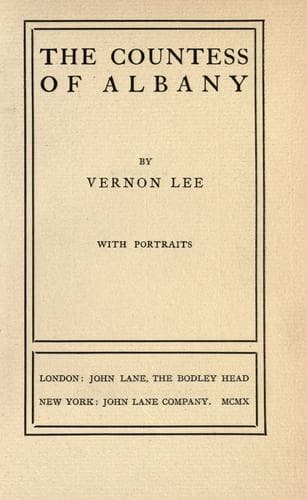
Albany, Louise Maximiliane Caroline Emanuele, Princess of Stolberg-Gedern, calling herself Countess of, 1752-1824
Two or three years after Alfieri's death, somewhere about the year 1806
or 1807, there was introduced to Mme. d'Albany a sort of half-Italian,
half-French Swiss, a man young in years and singularly young--with the
peculiar earnestness, gravity, purity which belongs sometimes to
youth--in spirit, Jean Charles Leonard Simonde de Sismondi. Quietly
idealistic, with one of those northern, eminently Protestant minds which
imagine the principle of good to be more solemnly serious, the principle
of evil more vainly negative, than is, alas, the case in this world--M.
de Sismondi, full of the heroism of mediaeval Italy which he was studying
with a view to his great work, came to the house of Alfieri, to the
woman whom Alfieri had loved, as to things most reverend and almost
sacred. The Countess of Albany received him very well; and this good
reception, the motherly cordiality of this woman with that light in her
hazel eyes, that welcoming graciousness in the lines of her mouth, which
Lamartine has charmingly described, with the "_parole suave, manieres
sans appret, familiarite rassurante_," "which made one doubt whether she
was descending to the level of her visitor, or raising him up to her
own,"--this reception by this woman, who was, moreover, still surrounded
by a halo of Alfieri's glory, fairly conquered the heart, the pure,
warm, grave and truthful heart of young Sismondi. He saw her often, on
his way between Geneva, whither he was called by his family business and
his lectures, and Pescia, a little town nestled among the olives of the
Lucchese Apennine, where he was for ever sighing to join his mother, to
resume his walks, his readings with this noble old woman. Florence, the
house on the Lung Arno, had an almost romantic fascination for Sismondi;
those passing visits, at intervals of months, when Mme. d'Albany would
devote herself entirely to the traveller, sit chatting, or rather (we
feel that) listening to the young man's enthusiastic talk about liberty,
letters, and philanthropy, about Alfieri and Mme. de Stael, enabled
Sismondi to make up for himself a sort of half-imaginary Countess of
Albany, to whom he poured out all his hopes and fears in innumerable
letters, for whom he longed as (alas!) we perhaps long only for the
phantoms of our own creating. That Mme. d'Albany was, after all, a
shallow woman; that she adored a mediocre M. Fabre (to whom Sismondi
invariably sent respectful messages) and half disliked the memory of
Alfieri; that she had called Mme. de Stael, Sismondi's goddess, about
whom he was for ever expatiating, "a mad woman who always wants to
inspire passions, and feels nothing, and makes her readers feel nothing"
(I am quoting from an unpublished letter at Siena); that she preferred
despotism on the whole to liberty, and had no particular belief or
interest in the heroic things of the present and future; that she was a
lover of gossip and scandal, sometimes (as Gino Capponi says) hard and
Public-domain text, read in full here on John Shaqi.
Reviews
Reviews
No reviews yet
Be the first to share your thoughts on this work.
Elsewhere in the archive
Join the Discussion
Join the discussion
Sign in to leave a comment or review.
Sign InorCreate an account