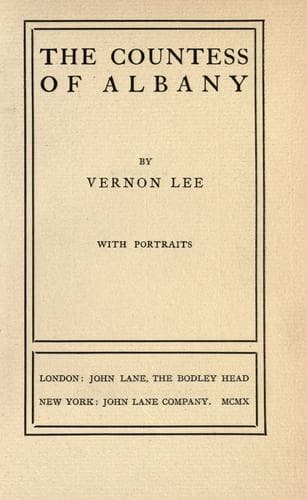
Albany, Louise Maximiliane Caroline Emanuele, Princess of Stolberg-Gedern, calling herself Countess of, 1752-1824
disagreeable; that she inspired some men, like d'Azeglio and Giordani,
with a positive repulsion as a vulgar-minded, spiteful, meddlesome old
thing; that there should be any other Mme. d'Albany than the one of his
noble fancy, than the woman whose image (fashioned by himself) he loved
to unite with the image of his own sweet, serious, shy, noble-minded
mother: all these things M. de Sismondi, who never guessed himself to be
otherwise than the most unpoetical and practical of men, never dreamed
of. So Sismondi went on writing to Mme. d'Albany, pouring out his grief
at Mme. de Stael's persecutions, his schemes of general improvement, all
the interests which filled his gentle, austere, and enthusiastic mind.
1814 came, and 1815. Sismondi had always hated, with the hatred of an
Italian mediaeval patriot, and the hatred of an eighteenth-century
philanthropist, the despotism, the bureaucratic levelling, the great
military slaughters of Napoleon; but when he saw Napoleon succeeded by
the inept and wicked governments of the Restoration, his heart seemed to
burst. A Swiss, scarcely acquainted with France, the passion for the
principles of liberty and good sense and progress which France had
represented, the passion for France itself, burst out in him with
generous ardour. This man suffered intensely at what to him, as to Byron
and to Shelley (we must recollect the introduction of the _Revolt of
Islam_), seemed the battle between progress and retrogression; and
suffered all the more as he was too pure and just-minded not to feel the
impossibility of complete sympathy with either side. Mme. d'Albany
answered his letters with Olympic serenity. What was it to her which got
the upper hand? She was by this time one of those placid mixtures of
optimism and pessimism which do not expect good to triumph, simply
because they do not care whether good does triumph. Sismondi, in his
adoration of her, thought this might be the result of a superior
magnanimity of character; yet he kept conjuring her to take an interest
in the tragedy which was taking place before her eyes. If she will take
no interest, will not Fabre? "Does M. Fabre not feel himself turning
French again?" writes Sismondi, and there is a pathetic insistency
in the question. Fabre thought of his pictures, his collections of
antiques, perhaps of his dinner; of anything save France and political
events. Mme. d'Albany smiled serenely, and chaffed Sismondi a little for
his political passions. Sismondi, of all men the most loyal to the idea
he had formed of his friends, seems never to have permitted himself to
see the real woman, the real abyss of indifference, beneath his ideal
Mme. d'Albany. But there are few things more pathetic, I think, than the
letters of this enthusiastic man to this cold woman; than the belief of
Sismondi--writing that the retrograde measures of which he reads in the
papers give him fits of fever, that the post days on which he expects
Public-domain text, read in full here on John Shaqi.
Reviews
Reviews
No reviews yet
Be the first to share your thoughts on this work.
Elsewhere in the archive
Join the Discussion
Join the discussion
Sign in to leave a comment or review.
Sign InorCreate an account