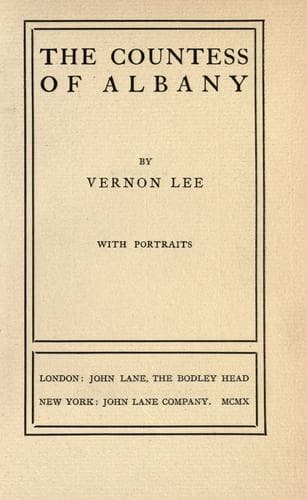
Albany, Louise Maximiliane Caroline Emanuele, Princess of Stolberg-Gedern, calling herself Countess of, 1752-1824
political news are days of frenzied expectation--in the moral fibre,
the faculty for indignation, of this pleasant, indifferent, cynical
quasi-widow of Alfieri.
The story of the Countess and Foscolo is an even sadder instance of
those melancholy little psychological dramas which go on, unseen to the
world, in a man's soul; little dramas without outward events, without
deaths or partings or such-like similar visible catastrophes, but the
action of which is the slow murder of an affection, of an ideal, of a
belief in the loyalty, sympathy, and comprehension of another. The
character and history of Ugo Foscolo, like Chenier, half a Greek in
blood, and more than half a Greek in passionate love of beauty and
indomitable love of liberty, are amongst the most interesting in Italian
literature; and I regret that I can say but little of them in this
place. Reviewing his brief life, his long career from the moment when,
scarcely more than a boy, he had entered the service of liberty as a
soldier, a political writer, and a poet, only to taste the bitterness of
the betrayal of Campo Formio, he wrote, in 1823, from London, where he
was slowly dying, to his sister Rubina: "I am now nearly forty-six;
and you, although younger than myself, can recollect how miserable,
how unquiet and uncertain our lives have always been ever since our
childhood." Poor, vain, passionate and proud, torn between the selfish
impulses of an exactingly sensuous and imaginative nature, and the rigid
sense of duty of a heroic and generous mind, Ugo Foscolo was one of the
earliest and most genuine victims of that sickness of disappointed hope
and betrayed enthusiasm, of that _Weltschmerz_ of which personal
misfortunes seemed as but the least dreadful part, that came upon the
noblest minds after the Revolution, and which he has painted, with
great energy and truthfulness, in his early novel _Jacopo Ortis_. His
career broken by his determination never to come to terms with any
sort of baseness, his happiness destroyed by political disappointment,
literary feuds, and a number of love affairs into which his weaker, more
passionate and vainer, yet not more ungenerous temper was for ever
embroiling him, Foscolo came to Florence, ill and miserable, in the year
1812. The Countess of Albany, recognising in him a something--a mixture
of independence, of passion, of vanity, of truthfulness, of pose--which
resembled Alfieri in his earlier days (though, as she was unable to
see, a nobler Alfieri, wider-minded, warmer-hearted, born in a nobler
civilization and destined to give to Italy a nobler example, the pattern
for her Leopardi, than Alfieri had been able to give)--the Countess of
Albany received Foscolo well. His letters are full of allusions to the
hours which he spent seated at the little round table in Mme. d'Albany's
drawing-room, opposite to the "Muse" newly bought of Canova, narrating
to her his many and tangled love affairs; love affairs in which he left
Public-domain text, read in full here on John Shaqi.
Reviews
Reviews
No reviews yet
Be the first to share your thoughts on this work.
Elsewhere in the archive
Join the Discussion
Join the discussion
Sign in to leave a comment or review.
Sign InorCreate an account