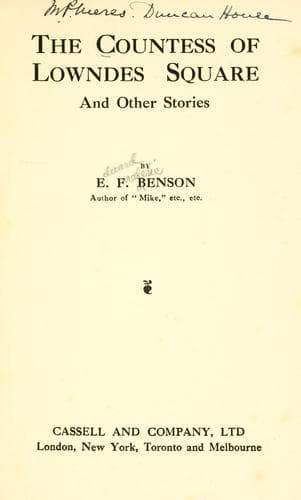
The Countess of Lowndes Square, and Other StoriesBenson, E. F. (Edward Frederic)
General
The Countess of Lowndes Square, and Other Stories
Benson, E. F. (Edward Frederic)
English fiction -- 20th century; Short stories, English
Richard Waghorn was among the cleverest and most popular of professional
mediums, and a never-failing source of consolation to the credulous.
That there was fraud, downright, unadulterated fraud mixed up with his
remarkable manifestations it would be impossible to deny; but it would
have been futile not to admit that these manifestations were not wholly
fraudulent. He had to an extraordinary degree that rare and inexplicable
gift of tapping, so to speak, not only the surface consciousness of
those who consulted him, but, in favourable circumstances, their inner
or subliminal selves, so that it frequently happened that he could speak
to an inquirer of something he had completely forgotten, which
subsequent investigation proved to be authentic.
So much was perfectly genuine, but he gave, as it were, a false frame to
it all by the manner in which he presented these phenomena. He
pretended, at his séances, to go into a trance, during which he was
controlled sometimes by the spirit of an ancient Egyptian priest, who
gave news to the inquirer about some dead friend or relative, sometimes
more directly by that dead friend or relative who spoke through him.
As a matter of fact, Waghorn would not be in a trance at all, but
perfectly conscious, extracting, as he sat quiescent and with closed
eyes, the knowledge, remembered or even forgotten, that lurked in the
mind of his sitter, and bringing it out in the speech of Mentu, the
Egyptian control, or of the lost friend or relative about whom inquiry
was being made. Fraudulent also, as purporting to come from the
intelligence of discarnate spirits, were the pieces of information he
gave as to the conditions under which those who had “passed over” still
lived, and it was here that he chiefly brought consolation to the
credulous, for he represented the dead as happy and busy, and full of
spiritual activities. This information, to speak frankly, he obtained
entirely from his own conscious mind. He made it up, and we cannot
really find an excuse for him in the undoubted fact that he sincerely
believed in the general truth of all he said when he spoke of the
survival of individual personality.
Finally, deeply dyed with fraud, and that in crude, garish colours, were
the spirit-rappings, the playing of musical boxes, the appearance of
materialized spirits, the smell of incense that heralded Cardinal
Newman, all that bag of conjuring tricks, in fact, which disgraces and
makes a laughing-stock of the impostors who profess to be able to bring
the seen world into connection with the unseen world. But to do Waghorn
justice, he did not often employ those crude contrivances, for his
telepathic and thought-reading gifts were far more convincing to his
sitters. Occasionally, however, his powers in this line used to fail
him, and then, it must be confessed, he presented his Egyptian control
with every trapping and circumstance of degrading device.
Public-domain text, read in full here on John Shaqi.
Reviews
Reviews
No reviews yet
Be the first to share your thoughts on this work.
Elsewhere in the archive
Join the Discussion
Join the discussion
Sign in to leave a comment or review.
Sign InorCreate an account