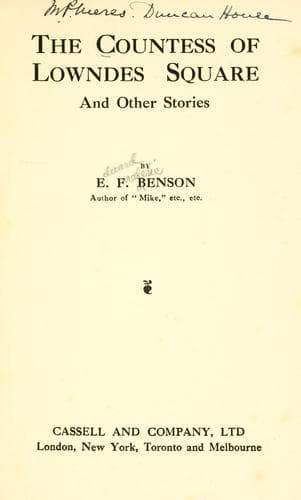
The Countess of Lowndes Square, and Other StoriesBenson, E. F. (Edward Frederic)
General
The Countess of Lowndes Square, and Other Stories
Benson, E. F. (Edward Frederic)
English fiction -- 20th century; Short stories, English
Sometimes, as he had done this afternoon, he would read a story of the
sea, and thus, without terror of shipwreck or qualms of nausea, listen
to the crash of menacing waves and the throb of the racing screw.
Sometimes he would spend an hour in the country, while his unerring
needle made daffodils and lambs; or, with a strong effort of the
imagination, travel across France to the delightful shores of the
Riviera with a vividness derived from the Continental Bradshaw. A sniff
at the lemon brought in with a tray of wafer biscuits and a siphon could
give him the effect of a saunter through the lemon groves outside Nice,
and the jingle of money in his pocket recalled the Casino at Monte
Carlo, where he saw himself amassing a colossal fortune in a single
night, and losing it all again. As a matter of fact, he never set foot
in the real Temple of Chance, because there were so many bold females
there who looked at his handsome face with such friendly, if not
provocative, glances. For though in imagination he was a perfect Don
Juan, the merest glance of interest from a female eye would send him
scurrying back like a lost lamb to the protective austerity of Alice.
To-night it seemed to him that the habits and instincts of years came
about him in crowds, asking him to classify them and construct a
definite theory about them for use in practical life, and suddenly, in a
flash of illumination, he saw the cohering principle on which he had
acted so long without consciously formulating it. He had always hated
real people, real experiences, the sun, the wind, the rain, but equally
had he loved the counterfeits of them as presented by Art in its various
forms, and by the suggestions that a lemon or a continental Bradshaw or
a piece of wool-work could give him. The theory that held all these
things together was that life for him consisted of imagination, not of
experience, and the practical application of that was to study and soak
himself in the suggestions that gave him the sting of experience,
without any sordid contact with life. To make a fortune (or lose one) at
Monte Carlo would have implied setting cheek to jowl with bold, bad
people, and risking a great deal of money. It was infinitely better to
study the time-table of the trains to Monte Carlo, sniff a lemon, and
jingle his money in his pocket; while if he wanted the sense of the
hot, smoke-laden, scent-heavy atmosphere, he must smoke a cigarette and
sprinkle his handkerchief with musk or frangipane. A pack of cards
thrown about the table would assist the illusion, and he could say,
“_Faites vos jeux, messieurs et mesdames_,” in the chanting monotone of
the croupiers.
Public-domain text, read in full here on John Shaqi.
Reviews
Reviews
No reviews yet
Be the first to share your thoughts on this work.
Elsewhere in the archive
Join the Discussion
Join the discussion
Sign in to leave a comment or review.
Sign InorCreate an account