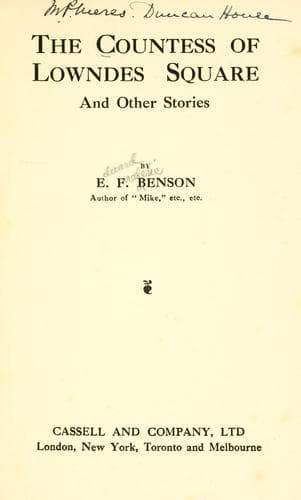
The Countess of Lowndes Square, and Other StoriesBenson, E. F. (Edward Frederic)
General
The Countess of Lowndes Square, and Other Stories
Benson, E. F. (Edward Frederic)
English fiction -- 20th century; Short stories, English
Picture him, then, with his plump, amiable face bent over Phœbe’s
imaginings, a perennial pipe in his mouth, and, invariably, two or three
little tufts of cotton-wool struck on to his cheek or chin, where he had
cut himself shaving that morning. Occasionally, but very rarely, he had
to go into the drawing-room to ask the elucidation of some situation:
how, for instance, was Algernon Montmorency to leap lightly out of the
window, and so regain his motor-car, when Phœbe had laid the scene in
the top room of the moated tower of Eagles Castle? But Phœbe could
always suggest a remedy which cost the minimum of readjustment, and ten
minutes afterwards Algernon would be thundering along the road with the
lurid Semitic moneylender in close pursuit. But for such occasional
interruption and the periodical lighting of his pipe he would not pause
for a second till the morning’s work was over. He never hesitated for a
word, for he had at his command the entire vocabulary of English
_clichés_, and he often got through two instalments before lunch. At one
precisely the parlourmaid came in, and groping through the fog of
tobacco-smoke, opened all the windows and began to lay the table. Upon
which Philip washed off his tufts of cotton-wool, snatched Phœbe from
her imaginative visions, and strolled in the garden with her till the
gong summoned them to the recuperative spell of a mutton chop and a
glass of blood-making Australian Burgundy.
After lunch they drove in the motor-car, returning for tea, and from tea
till dinner they read over aloud and discussed their morning’s work. In
this way Philip made acquaintance with the subject-matter he would be
employed on next morning, and Phœbe learned how that which she had
written yesterday had turned out. Philip had never any criticism to
make: his wife’s imagination seemed to him one of the most glorious
instruments ever devised for the delectation of the literary, and she
often said that of all contemporary novelists her husband was the only
man capable of handling the situations she poured out in this unending
flood. After dinner they played patience, went early to bed, and awoke
with an unquenchable zest for the labour and rewards of another day.
* * * * *
Public-domain text, read in full here on John Shaqi.
Reviews
Reviews
No reviews yet
Be the first to share your thoughts on this work.
Elsewhere in the archive
Join the Discussion
Join the discussion
Sign in to leave a comment or review.
Sign InorCreate an account