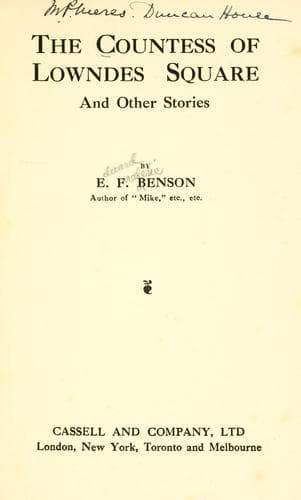
The Countess of Lowndes Square, and Other StoriesBenson, E. F. (Edward Frederic)
General
The Countess of Lowndes Square, and Other Stories
Benson, E. F. (Edward Frederic)
English fiction -- 20th century; Short stories, English
It was when his condition was at its worst that there gleamed a light
through the tunnel of his despair. The editor of the _Yorkshire
Telegraph_, who wanted another story by the Partingtons, with the
shortest possible delay, wrote to him suggesting in the most delicate
manner that life in New York would present an admirable setting for a
tale, especially since the United States had come into the war, and
offering to pay his passage to that salubrious city if he would
favourably consider this proposal. And all at once Philip remembered
having read in some book of physical geography, studied by him in
happier boyish days, that the Atlantic in certain places was not less
than seven miles deep....
He read this amiable epistle to his wife.
“Upon my word, it sounds a very good plan,” he said brightly. “What do
you say, Phœbe? It will give me the holiday of which you think I stand
in need.”
Phœbe shook her head.
“Do you propose that I should come with you?” she asked. “Why should a
holiday among the submarines do you more good than the Malvern Hills?”
The thought of the deep holes in the Atlantic grew ever more rosy to
Philip’s mind. Even the hideous notion of being torpedoed failed to take
the colour out of it.
“My dear, these are days in which a man must not mind taking risks,” he
said.
She smiled at him.
“I know your fearless nature, darling,” she said; “but what is the point
of running unnecessary risks?”
“Local colour. There is a great deal in Mr. Etherington’s remarks.”
“I don’t agree. I should think with our experience we ought to be able
to describe New York without going there. We didn’t find it necessary to
go to Athens, or Khartoum, or Mexico.”
“True,” said he; “but perhaps my descriptions might have gained in
veracity if we had. That was a tiresome letter to the _Yorkshire
Telegraph_ about the spires on the Acropolis. If we had been there, we
should have known that there weren’t any.”
He fingered the stud-box in his pocket for a moment, and his fingers
itched to drop it over a ship’s side.
“My part of our joint work might gain in true artistic feeling,” he
said, “if I described what I had actually seen. Art holds the mirror up
to nature, you know.”
“Yes, darling; but do you think Shakespeare meant that Art must hold the
mirror up to New York?” asked she. “I fancy there is very little nature
in New York.”
He took a turn or two up and down the room, while the box positively
burned his finger-tips.
“I can’t help feeling as I do about it,” he said. “And, Phœbe, one of
our earliest vows to each other was that each of us should respect the
other’s literary conscience!”
She got up.
“You disarm me, dear,” she said. “Apply for your passport, and if they
give it you, go. I only ask you to respect my feminine weakness and not
make me come with you among all those horrid submarines.”
They sealed their compact with a kiss.
Public-domain text, read in full here on John Shaqi.
Reviews
Reviews
No reviews yet
Be the first to share your thoughts on this work.
Elsewhere in the archive
Join the Discussion
Join the discussion
Sign in to leave a comment or review.
Sign InorCreate an account