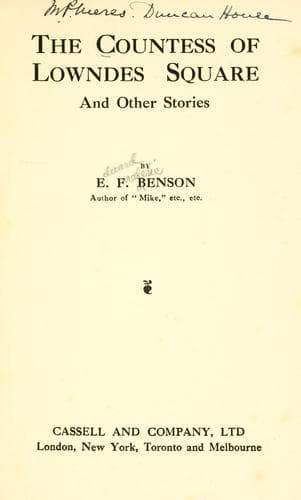
The Countess of Lowndes Square, and Other StoriesBenson, E. F. (Edward Frederic)
General
The Countess of Lowndes Square, and Other Stories
Benson, E. F. (Edward Frederic)
English fiction -- 20th century; Short stories, English
By the time Phœbe had interviewed her cook, her husband had already
written his letter applying for his passport, on the grounds of artistic
necessity in his profession. She read it through with high approval.
“Very dignified and proper,” she said. “By the way, dear, there will be
no work for us this morning. We are going over the factory for
explosives with kind Captain Traill. You and I must observe the
processes very carefully, as we want all the information we can get for
‘The Hero of Ypres.’”
He jumped up with something of his old alacrity.
“Aha, there speaks your artistic conscience,” he said. “And don’t let me
see too many soft glances between you and kind Captain Traill.”
Phœbe looked hugely delighted and returned the compliment.
“And there are some very pretty girls working there,” she observed
slyly.
An hour afterwards they were padding in felt slippers round the room
where bombs were packed with a fatal grey treacle, one spoonful of which
was sufficient to blow them and the whole building into a million
fragments. A new type of bomb was being made there, consisting of a
cast-iron shell fitted with a hole through which the grey treacle was
poured; an iron stopper was then screwed into the hole. There were
hundreds of those empty shells, which slid along grooved ways to where
the treacle was put into them, and they then were passed on to the
girls, who fixed their stoppers. It was all soft, silent, deadly work,
and Philip recorded a hundred impressions on his retentive memory.
Phœbe and Captain Traill were walking just ahead of him, when suddenly a
great light broke, so vividly illuminating his brain that he almost
thought some terrific explosion, seen and not heard, had occurred.
Stealthily he drew from his pocket the stud-case, stealthily he opened
it and took out the razor-blade. Then, bending over an empty bomb-case
as if to examine it, he dropped the blade into it. It fell inside with a
slight chink, which nobody noticed.
A couple of minutes afterwards the bomb-case had passed through the
hands of the dispenser of treacle, and had its stopper screwed in.
“And where are all those little surprise packets going?” asked Philip
airily.
“To aeroplanes on the west front,” said kind Captain Traill. “We’re
sending off a lot to-night. Perhaps that one”--and he pointed to the
identical bomb which Philip had had a hand in filling--“will make a mess
in Mannheim next week.”
“I hope so,” said Philip fervently.
The only thing, now that Philip had disposed of the razor-blade, that
clouded his complete content was the fear that his passport would be
granted him, and that he would have to make a journey to America.
Happily no such unnerving calamity occurred, for a week later he
received a polite intimation from the passport office that the object
for which he wanted to go there did not seem of sufficient importance to
warrant the granting of a permit; so, wreathed in smiles, he passed this
letter over to Phœbe.
Public-domain text, read in full here on John Shaqi.
Reviews
Reviews
No reviews yet
Be the first to share your thoughts on this work.
Elsewhere in the archive
Join the Discussion
Join the discussion
Sign in to leave a comment or review.
Sign InorCreate an account