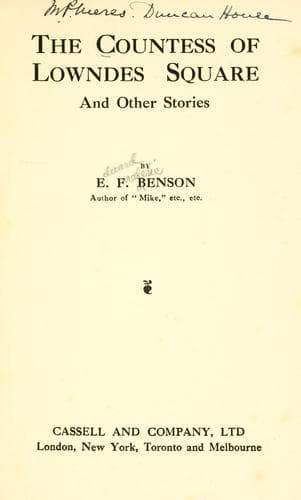
The Countess of Lowndes Square, and Other Stories — John Shaqi
The Countess of Lowndes Square, and Other StoriesBenson, E. F. (Edward Frederic)
General
The Countess of Lowndes Square, and Other Stories
Benson, E. F. (Edward Frederic)
English fiction -- 20th century; Short stories, English
Suddenly the paper which he held began to rustle with the involuntary
tremor of the hand that held it, and an eager excitement shot up like
the light of a petroleum-soaked beacon in his dulled eye. He need no
longer seek for agitation. He had found, when he least expected it, the
answer to his fruitless appeals to the universe to supply him with
interest. In the excitement of the moment he poured a liberal dose of
whisky into a tumbler, but next minute poured it back. He had to keep
his head cool; artificial stimulant only led to subsequent reaction and
torpidity of thought. But through the prison bars his spirit grasped
hands with the archdeacon’s victim. He would certainly blackmail
somebody.
There were two questions to settle. Whom should he blackmail, and what
had his victim done? A moment’s incisive thought told him that the
second question, as to what the supposed crime had been, was alien and
superfluous. The poor man need not have done anything. He need only be
told that the events which occurred between, say, August 2 and August 10
of the year before last were known to his persecutor. All else depended
on the selection of a suitable victim. If an unsuitable subject was
chosen, one whose life (could such be found) was of virtue so
monstrously Spartan, that he would not mind the events of August 2 to
10, or those of any other date, being known, it was clearly impossible
to proceed. On the other hand, if his life was so voluminous a catalogue
of crime that there were terrible affairs in every week of it, a
notified period like this would create no particular impression.
Yes, it was the character of the victim that must be studied if the
æsthetic blackmailer was to have any fun, for, of course, in the case of
Arthur Whately, the mere extraction of two or three hundred pounds
(thousands, perhaps, if his prey was wealthy) meant nothing at all. And
the largest ingredient in the fun would be the uncertainty as to how the
victim would behave, whether he would take proceedings or pay. He must
therefore be cast in no iron mould; there would be little sport in
writing just one letter and then being sent to join the poor worm so
grindingly crushed by the heel of the valiant archdeacon, nor, on the
other hand, would there be any zest in the punctual receipts of cheques
whenever demanded. He had to think of somebody not too good and not too
bad, not too brave and yet not pigeon-livered. For a while his mind
hovered, singing like a skylark in the exultation of this absorbing
preoccupation, then suddenly it dropped to earth again. There was none
so fit as Lord Peebles.
His hand trembled for the pen that was mightier than the sword, and
after a few moments’ concentrated thought, he dashed off these cold,
cruel lines, which would serve as the basis for attack:
Public-domain text, read in full here on John Shaqi.
Reviews
Reviews
No reviews yet
Be the first to share your thoughts on this work.
Join the Discussion
Join the discussion
Sign in to leave a comment or review.
Sign InorCreate an account