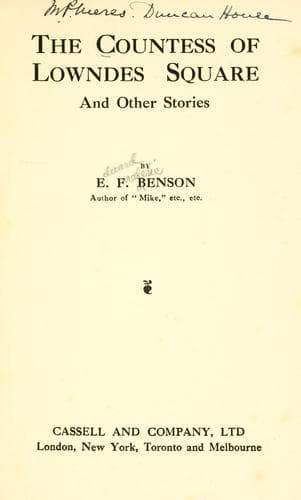
The Countess of Lowndes Square, and Other StoriesBenson, E. F. (Edward Frederic)
General
The Countess of Lowndes Square, and Other Stories
Benson, E. F. (Edward Frederic)
English fiction -- 20th century; Short stories, English
“Yes, Roland Somerville is marvellous in the part,” she said, “and I
told him he had never done a finer piece of work. But I thought Margaret
had not quite grasped his conception of it. I went round, of course, to
see her afterwards, and as she asked me what I thought I told her just
that.”
At this moment the telephone bell rang in the room adjoining, and Mrs.
Withers, though continuing to analyse the play with her accustomed
acumen (it had produced precisely the same effect on her as on the
author of the critique in the _Daily Herald_) was a little _distraite_
in manner till her parlour-maid communicated the message.
“Ah, that accounts for Hugh Chapel’s absence, who was to have sat
between us,” she said to Agnes. “He was sent for to the Palace at a
quarter-past one and is lunching there. And I ordered golden plovers
especially for him. Hugh was at Priscilla’s last night, looking very
tired, I thought. You know him, of course, Miss Lockett?”
Agnes was looking a little dazed.
“Not yet,” she said. “You asked me here to meet him.”
Mrs. Withers made a gesture of impatience at herself. As a matter of
fact she had, in asking Agnes Lockett, told her that Mr. Chapel was
coming, and in asking him, had told him that Miss Lockett was coming,
thus hoping to kill two lions with one lunch.
“Of course! How stupid of me,” she said. “Let us instantly arrange
another day when you can both be here. Ah! do come to a little party I
have on Thursday night. You will find Lord Marrible here too; he only
got back from America ten days ago. Poor Jack! he had a terrible voyage,
and he is such a bad sailor.”
A look of slight astonishment came over Agnes’s face, and remembering
that she and Lord Marrible were old and intimate friends, I wondered
whether she was surprised at this odd allusion to “poor Jack,” for he
was known to his intimate circle as John. Personally, I had had the
felicity of making him and my hostess known to each other only a few
days ago, and I too wondered a little at the speedy ripening of the
acquaintanceship. I did not wonder much, for I knew Mrs. Withers’s
friendly disposition, and her tendency to allude to everybody by his
Christian name. But at the moment a too rash act of swallowing on the
part of Dickie Sebastian, who sat next me, made it my duty towards my
neighbour to thump him on his fat back for fear that we should never
hear his violin again, and my attention was distracted. When the
fish-bone in question had been safely deposited on the edge of his
plate, the telephone had again been ringing, and Mrs. Withers was
retailing the reason for the absence of somebody called Humphrey, whose
place I conjectured that I was now occupying.
Public-domain text, read in full here on John Shaqi.
Reviews
Reviews
No reviews yet
Be the first to share your thoughts on this work.
Join the Discussion
Join the discussion
Sign in to leave a comment or review.
Sign InorCreate an account