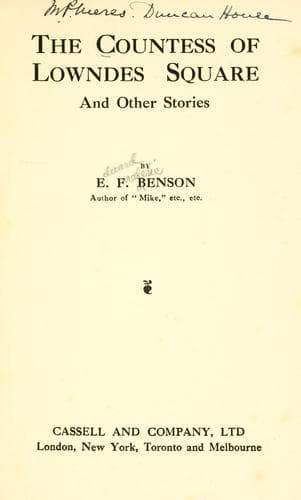
The Countess of Lowndes Square, and Other Stories — John Shaqi
The Countess of Lowndes Square, and Other StoriesBenson, E. F. (Edward Frederic)
General
The Countess of Lowndes Square, and Other Stories
Benson, E. F. (Edward Frederic)
English fiction -- 20th century; Short stories, English
“Not at all; that is the humorous side of it. It is to save ourselves
that we have got to build up this solid, splendid presentment of our
friend, and that is why I am telling you so carefully all I have said
about him to Mrs. Withers. When it comes to your turn, as it undoubtedly
will, to describe him further, you must always telephone to me at once
what you have said.... Where had we got to? Oh, yes, his poems. Haven’t
you got some joyous little lyrics in your desk which are his? Or better,
some vague morbid little wailings? Yes: that shall be the other side of
Robbie, known only to his most intimate friends. To the world, which
worships him, he is all sunshine and splendour, but to us, his dear
friends, there is another side. His grandmother was a Russian, you must
remember. I think I had better write the poems.”
Somehow, incredibly to myself, the fascination of creating and building
up and furnishing out a wonderful young man like this, who had no
existence whatever, began to gain on me. Also, as Agnes had said, there
was the instinct of self-preservation to spur on the imaginative
faculty. There was also the pleasure of going one better than Mrs.
Withers and of pretending to know intimately somebody whom nobody could
possibly know.
“He is an orphan,” I said. “And may he be an American? That would make
him easier to get rid of than if he was English.”
She shook her head.
“Orphan--yes,” she said. “American--no. I can’t bear American poetry,
and I am sure I couldn’t write it. But his parents lived in India. They
are both dead, and he hasn’t got any relations whatever, which makes him
so romantic and accounts for that salt soul-loneliness in his poems. We
will give him a home--just a little remote house by the sea, in
Cornwall, near St. Ives, and the Atlantic rolls in on the beach in front
of his grey-walled garden. His poems have the beat and rhythm of the
sea----”
I sprang from my chair.
“Never, never!” I cried. “Mrs. Withers goes to St. Ives every summer.”
“We will give him his home, then, in the Lake District,” said Agnes
thoughtfully. “There is no beat and rhythm of the sea in his poems, but
the eternal melancholy of lakes and mountains. He must have somewhere
pretty far off to go to when he is demobilized, as he will be almost
immediately. His constant presence in London would lead to detection.”
“Then why demobilize him?” I asked. “He can always be in France when it
is convenient to us.”
She was quite firm about this.
“It would never do,” she said. “Mrs. Withers might make inquiries about
him from some General in the Flying Corps. Indeed, I am almost sorry he
was an airman at all, but that can’t be helped now.”
“He can go to India to see his parents’ graves,” said I, “if we want to
get him out of the country for a long period.”
Public-domain text, read in full here on John Shaqi.
Reviews
Reviews
No reviews yet
Be the first to share your thoughts on this work.
Join the Discussion
Join the discussion
Sign in to leave a comment or review.
Sign InorCreate an account