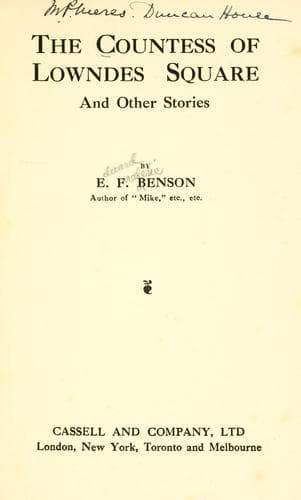
The Countess of Lowndes Square, and Other StoriesBenson, E. F. (Edward Frederic)
General
The Countess of Lowndes Square, and Other Stories
Benson, E. F. (Edward Frederic)
English fiction -- 20th century; Short stories, English
“What, is Robbie here?” he asked, thereby conveying to me that he was an
Oriolist. “I didn’t see him. If Robbie is in a room it’s not easy to
miss him. I didn’t even know he was in town.”
“Of course he is,” said Agnes. “Fancy not knowing if Robbie is in town.
You might as well not know----”
“If the sun is shining,” said I fervently.
“Quite. Lord Marrible, do go back and see if he isn’t there. He and Mr.
Goodenough and I are going back to his flat, and he is going to read to
us. And then he is going to play the piano and then I suppose it will be
time for breakfast before we have talked enough.”
Mrs. Withers rose like a great salmon fresh from the sea, and rushed at
this wonderful lure.
“I never heard anything so improper,” she said. “You and--and Mr.
Goodenough and Robbie Oriole! My dear Miss Lockett, who is chaperoning
you?”
Agnes’s face dimpled into the most delicious smile.
“Ah, we don’t want any chaperon in the sunlight,” she said, as John
shouldered his way back into the music-room.
“Then let me drop you all at his flat,” said Mrs. Withers. “I have my
motor here, and I’m going home now. I am sure it is not out of my way.”
Agnes nudged me with her elbow to indicate that I had to answer this.
“Robbie’s car is here, many thanks,” I said. “It’s waiting for us. I saw
it when I came in.”
“And he plays the piano too?” asked Mrs. Withers.
Agnes laughed.
“Ah, I believe you know him all the time,” she said, “and mean to repeat
to him all the nice things that we say about him. You know him
intimately, I believe, but if you tell me that he has already sent you
those three sonnets he wrote as he flew to Cologne the other day, which
he promised to read us to-night, I don’t think I could bear it. Mr.
Goodenough and I were promised the first hearing of them, and I believe
he has sent them to you already.”
“Indeed he hasn’t,” said Mrs. Withers in a social agony. “I really don’t
know Mr. Oriole, though I am dying to. I hoped you would have brought
him to my little party last Thursday.”
“Thursday, Thursday,” said Agnes. “Yes, I remember: Robbie was up in the
Lakes. Such a pity! He would have loved it, just the sort of party he
adores.”
Mrs. Withers’s brow, that Greek brow with a fillet of crimson velvet
across it, from which depended a splendid pearl, grew slightly
corrugated, and made the pearl tremble. She prided herself on knowing
all her engagements for a week ahead, but the recollection of them was
difficult even to her.
“Sunday at lunch then,” she said. “Will you both come and bring Mr.
Oriole? Tell him how divine it would be if he would read us the Cologne
sonnets.”
“I’ll tell Robbie,” said Agnes, “but as for your chance of finding him
disengaged, I couldn’t promise anything. How his friends grab him when
he appears! Ah, there’s John--I mean Lord Marrible. Well?”
“He simply isn’t here.”
Agnes turned to me.
Public-domain text, read in full here on John Shaqi.
Reviews
Reviews
No reviews yet
Be the first to share your thoughts on this work.
Join the Discussion
Join the discussion
Sign in to leave a comment or review.
Sign InorCreate an account