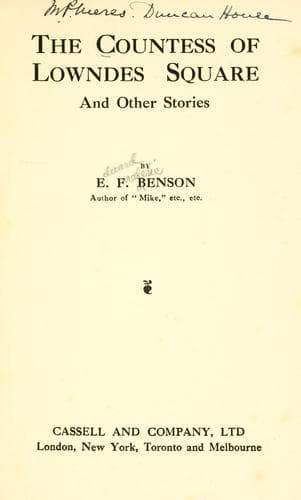
The Countess of Lowndes Square, and Other StoriesBenson, E. F. (Edward Frederic)
General
The Countess of Lowndes Square, and Other Stories
Benson, E. F. (Edward Frederic)
English fiction -- 20th century; Short stories, English
It was about this time that they both became members of the Psychical
Research Society, and their attention could not but be struck by the
wonderful phenomena resulting from the practice of automatic writing. If
you had a psychical gift in this direction--and it was now the settled
conviction of both Henry Andrews and his wife that they had--all
apparently that had to be done was to hold a pencil over a writing-pad
conveniently placed, abstract your mind from the hand that held the
pencil, and sit there to see what happened. The theory was that some
controlling spirit might take possession of the pencil and dictate
messages from the other world, which the pencil would record. Eager
study of the psychical journals warned them that patient practice might
be necessary before any results were arrived at, the reason being that
the control must get used to the novel instrument of communication; and
warning was given that they must not be discouraged if for a long time
nothing was recorded on the paper except meaningless lines. But it
appeared that most people, if they would only be patient enough, would
be rewarded by symptoms of the presence of a control before very long,
and when once a beginning was made, progress was apt to be very rapid.
It was recommended also that practice should be regular, and, if
possible, should take place at the same time every day.
The idea fired Mrs. Andrews at once.
“Upon my word, dear Henry,” she said, “I think it is very well worth
trying, for the crystal is yielding no results at all. Psychical gifts
are possessed by everybody in some degree, so this very interesting
article says, and if ours do not lie in the direction of crystal-gazing,
it makes it all the more probable that we shall achieve something in
automatic writing. And as for a regular time for practising it, what
could be more pleasant than to sit out in the garden after tea, when you
have come in from your golf, and enjoy these warm evenings, with the
feeling that we are occupying ourselves, instead of sitting idle, as we
are apt to do?”
Henry distinctly approved of the suggestion. He was often a little
fatigued after his golf, though he was going to live till ninety, and
the prospect of sitting quietly in a chair in the garden, instead of
feeling that he ought to be weeding, was quite a pleasant one.
“Then shall we each sit with paper and pencil, dear?” he asked.
Mrs. Andrews referred to the essay that gave elementary instruction.
“Certainly,” she said. “We will try that first. They say that two hands
holding the pencil often produce extraordinary results, but we will
begin, as they suggest, singly. I declare that my hand feels quite
fidgety already, as if the control was just waiting for the means of
communication to be prepared.”
Public-domain text, read in full here on John Shaqi.
Reviews
Reviews
No reviews yet
Be the first to share your thoughts on this work.
Elsewhere in the archive
Join the Discussion
Join the discussion
Sign in to leave a comment or review.
Sign InorCreate an account