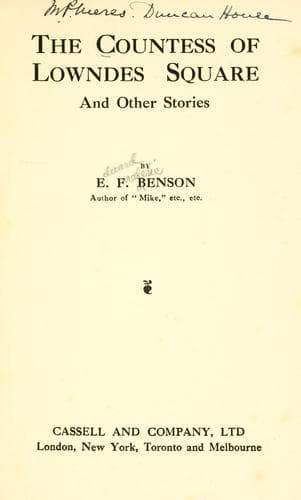
The Countess of Lowndes Square, and Other StoriesBenson, E. F. (Edward Frederic)
General
The Countess of Lowndes Square, and Other Stories
Benson, E. F. (Edward Frederic)
English fiction -- 20th century; Short stories, English
Everything in Mrs. Andrews’s house was in apple-pie order, and it took
her no time at all to find two writing-pads and a couple of sharpened
pencils. With these she rejoined her husband on the paved walk, where
they had had tea, outside the drawing-room, and, with pencil in hand,
fixed her eye firmly on the top of the mulberry tree at the edge of the
lawn, and waited. He, with left hand free for his cigarette, did the
same, but his mind kept going back to the boiled rabbit he had dreamed
of after crystal-gazing, which still seemed to him a very unusual
occurrence, for, to the best of his recollection, he had never dreamed
of boiled rabbit before.
Within a few days’ time very promising developments had taken place.
Almost immediately Mrs. Andrews had begun to trace angled lines on the
paper, which, if they did not suggest anything else particular, were
remarkably like the temperature chart of a very feverish patient. Her
hand, seemingly without volition on her part, made energetic dashes and
dabs all over the paper, and she felt a very odd tingling sensation in
her fingers, which could scarcely be put down to anything else than the
presence of the control.
Her husband, scarcely less fortunate, also began to trace queer patterns
of irregular curves on his sheet, which looked very much as if they
were words. But though they were like words, they were not any known
words, whichever way up you attempted to read them, though, as Mrs.
Andrews said, they might easily be Russian or Chinese, which would
account for their being wholly meaningless to the English eye. Sheets of
possible Russian were thus poured out by Mr. Andrews, and whole hospital
records of fever charts on the part of his wife, but neither at present
came within measurable distance of intelligibility. The control seemed
incapable of making itself understood. Then on a memorable day Mr.
Andrews’s pencil evinced an irresistible desire to write figures, and
after inscribing “one, two, one, two,” a great many times, wrote quite
distinctly 4958, and gave a great dash as if it had said its last word.
“And what 4958 indicates, my dear,” said he, passing it over to Mrs.
Andrews, “I think we must leave to the control to determine.”
She looked at it a moment in silence; then, a great thought splendidly
striking her, she rose in some excitement.
“Henry, it is as plain as plain,” she said. “I am forty-nine; you are
fifty-eight. Our ages are thus wonderfully conjoined. It certainly means
that we must act together. Come and hold my pencil with me.”
“Well, that is very curious,” said Henry, and did as he was told.
Public-domain text, read in full here on John Shaqi.
Reviews
Reviews
No reviews yet
Be the first to share your thoughts on this work.
Elsewhere in the archive
Join the Discussion
Join the discussion
Sign in to leave a comment or review.
Sign InorCreate an account