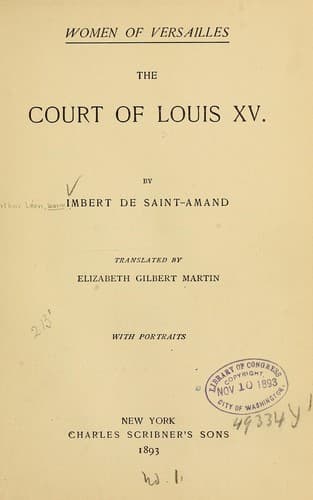
France -- Court and courtiers; France -- History -- Louis XV, 1715-1774
This truly evangelical language was the admiration of the Queen, the
Dauphin, and all pious people. But it seemed like a satire to the
protectress of the philosophers, the friend of Voltaire and Quesnay,
the patroness of the Encyclopedia. Louis XV. was in reality of the
Archbishop’s opinion. He recalled him in October, 1757. But, faithful
to his system of compromises, he permitted those members of the
Parliament who had resigned to resume their functions. The Archbishop,
constantly pursued by the animadversions of the favorite, was exiled
a second time, from January, 1758, to October, 1759. The inflexible
prelate conceded nothing in point of doctrine. “Let them erect a
scaffold in the midst of the court,” he exclaimed; “I would ascend
it to maintain my rights, fulfil my duties, and obey the laws of my
conscience.”
The quarrels over the bull _Unigenitus_ were at last appeased; but
religious authority was weakened at the same time as royal authority.
Emboldened by their polemics, the members of the Parliament began
gradually to pose as protectors of liberties and censors of absolute
monarchy. Some of the nobles, on the lookout for popularity, such as
D’Argenson, Choiseul, and other disciples of Voltaire, fancied that
the aristocracy could retain their privileges if the clergy lost
theirs. Louis XV., who foresaw the coming cataclysms, was under no such
illusion: at bottom he was inimical to the Parliament and friendly
to the Church. If the Most Christian King sometimes showed himself
indulgent toward the philosophers, it was because they flattered his
mistress and sought to stupefy him while lulling his remorse.
X
MADAME DE POMPADOUR AND THE SEVEN YEARS’ WAR
One of the principal calamities laid to the charge of Madame de
Pompadour, by her contemporaries and by posterity, is the Seven Years’
War. They have resolved to hold her responsible for all the bloodshed,
all the disasters and humiliations, for Rossbach and Crevelt, for the
loss of the colonies and the profound injury done to the military
prestige and naval forces of France. There is some exaggeration in
this, as we believe. It must not be forgotten that the origin of the
Seven Years’ War was an unjustifiable aggression of the English,
who were absolutely bent on complete mastery of the seas. Madame de
Pompadour was certainly not responsible for British ambition. It is
true that France was not ready for strife, and that its marine had been
allowed to fall into decay. But if the favorite was deceived about
the resources of the country, if she cherished illusions which ruined
peoples as well as individuals, she was not the only one.
Public-domain text, read in full here on John Shaqi.
Reviews
Reviews
No reviews yet
Be the first to share your thoughts on this work.
Elsewhere in the archive
Join the Discussion
Join the discussion
Sign in to leave a comment or review.
Sign InorCreate an account