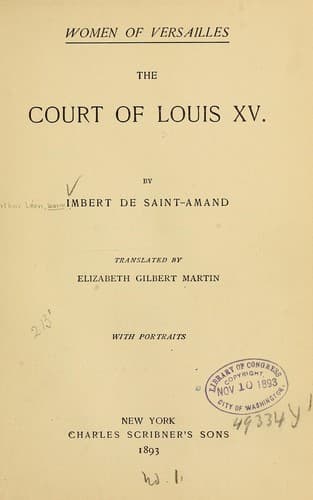
France -- Court and courtiers; France -- History -- Louis XV, 1715-1774
The Marquis d’Argenson accuses her of having been occupied with
porcelains at a time when people should have been thinking of arms.
“Madame de Pompadour,” he writes in 1754, “does nothing but preach up
the great advantage it has been to the State to manufacture porcelain
like that of Saxony, and even to have surpassed it. A royal warehouse
for this porcelain is being established in the rue de la Monnaie. There
may be seen a service which the King is about to send to the King of
Saxony, as if to brave and provoke him, saying that he has surpassed
even his manufactory. At the King’s suppers the Marquise says that it
is uncitizenlike not to buy as much of this porcelain as one can pay
for. Some one answered her: But while the King has been so liberal in
encouraging this manufactory, those of Charleville and Saint-Étienne
are abandoned, which are quite differently useful to us, since they
concern the defence of the kingdom, and three-quarters of the workmen
are passing into foreign countries.” The reflection is, doubtless,
just; but a few Saxony or Sèvres porcelains, more or less, would not
greatly have altered the situation of France. It was her misfortune to
be slumbering in a fatal ease. Voltaire has said: “All Europe never saw
happier days than followed the peace of Aix-la-Chapelle, in 1748, until
toward the year 1755. Commerce flourished from St. Petersburg to Cadiz;
the fine arts were everywhere in honor. A mutual confidence existed
between all nations. Europe resembled a large family, reunited after
its dissensions.” The French allowed themselves to be deceived by
this universal lull. Military men and diplomatists felt an exaggerated
confidence. In a few years people became so accustomed to peace that
they no longer even thought of war. It was the same thing that happened
about a century later, at the time of the Universal Exposition of
1867. Peoples who wish to preserve their greatness ought to beware
of cosmopolitan theories. While the philosophers were weaving their
humanitarian dreams, England was preparing her fleets and Frederick the
Great his armies.
A trifling contest between France and England for some wild lands in
Canada was the kindling spark of a fire that was to inflame the four
quarters of the earth. But this quarrel, insignificant in itself, was
not the true cause of the war: it was at most its pretext.
Public-domain text, read in full here on John Shaqi.
Reviews
Reviews
No reviews yet
Be the first to share your thoughts on this work.
Elsewhere in the archive
Join the Discussion
Join the discussion
Sign in to leave a comment or review.
Sign InorCreate an account