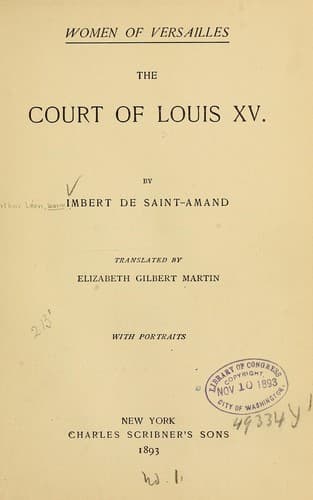
France -- Court and courtiers; France -- History -- Louis XV, 1715-1774
At the start, people were full of enthusiasm and confidence. The victor
of Mahon was esteemed as successful in war as in love. Nothing was
dreamed of but mighty feats and conquests. But presently all took on
a gloomy look. The convention of Closter-Seven, so imprudently signed
by Marshal de Richelieu on September 8, 1757, was the signal for
unnumbered catastrophes. “One does not die of grief,” wrote Bernis to
Choiseul, December 13 of the same year, “for I am still alive after
September 8. Since that epoch, faults have been accumulated in a
fashion one can hardly explain, without supposing bad intentions. I
have spoken with the greatest force to God and His saints. I excite
pulses a little, and then the lethargy recommences; people open big
eyes, and that is all there is about it.... It seems to me as if I were
minister of foreign affairs in Limbo. Try, my dear count, if you can
excite more than I the spirit of life which is becoming extinct in
us; for my part, I have dealt all my great blows, and have concluded
to be in an apoplexy like the others over sentiment, without ceasing
to do my duty like a good citizen and an honest man.” The former abbé
of the court become a minister, the once superficial man whom Voltaire
used to call “Babet, the-bouquet-holder,” was indignant at the general
apathy and carelessness. “It is unexampled,” wrote this friend of
Madame de Pompadour, “that so great a game should be played with the
same indifference as a game of checkers.... Sensitive, and, if I dare
say it, sensible as I am, I am dying on the wheel, and my martyrdom
is useless to France.... May God send us some will or other, or some
one who will have one for us! I would be his valet de chambre if they
liked, and with all my heart.”
As soon as the struggle began, unfortunate France was amazed at
the illusions she had cherished. The truth appeared to her. Bernis
comprehended that the shortest follies are the best. January 6, 1758,
he wrote to Choiseul, then Ambassador to Vienna: “My advice would be to
make peace, and to begin by a truce on land and sea. When I shall know
what the King thinks of this idea, which I have not found in my manner
of thinking, but which has been presented to me by good sense, reason,
and necessity, I will inform you. Meanwhile, try to make M. de Kaunitz
certain of two things that are equally true; namely, that the King will
never abandon the Empress, but that it will never do for him to be
ruined with her. Our respective faults have made a hopeless wreck of a
great project which was infallible in the first days of September. It
is a beautiful dream which it would be dangerous to carry further, but
which it might some day be possible to resume with better actors and
better combined military plans. The more directly I have been charged
with this grand alliance, the more ought people to credit me when I
counsel peace.”
Public-domain text, read in full here on John Shaqi.
Reviews
Reviews
No reviews yet
Be the first to share your thoughts on this work.
Elsewhere in the archive
Join the Discussion
Join the discussion
Sign in to leave a comment or review.
Sign InorCreate an account